

Casino game downtime is not just a technical interruption. For players, it can feel like a broken promise, especially if they were in the middle of a bonus round, trying a new slot, or switching to live casino games during peak hours.
The difference between a recoverable incident and a reputation problem often comes down to communication. Players do not need a database-level explanation, but they do need to know what is affected, whether their balance is safe, what to do next, and when you will update them again.
For online casino operators, the goal is simple: communicate fast enough to reduce uncertainty, clearly enough to prevent ticket spikes, and carefully enough to protect compliance, fairness, and trust.
Why downtime communication matters in online casinos
In most digital products, downtime is frustrating. In an online casino, it is emotional. Money, bonuses, wagering progress, tournament rankings, and unfinished game rounds can all be involved. If the lobby simply shows a spinning loader or a generic error, players will fill the gap with suspicion.
That suspicion quickly becomes expensive. Support queues grow, VIP managers get pulled into manual reassurance, social channels become complaint surfaces, and retention can suffer even after the game itself is back online.
Strong downtime communication helps operators:
- Reduce duplicate support tickets by answering the obvious questions first.
- Protect player trust by acknowledging impact instead of hiding it.
- Avoid inaccurate promises from support agents under pressure.
- Keep unaffected games, payments, and account services usable.
- Create an audit-friendly record of what was communicated and when.
The key is to treat communication as part of incident response, not as a last-minute message someone writes after players are already angry.
Separate player-impacting downtime from internal noise
Not every technical issue deserves a player-facing alert. If a back-office report is delayed but games, balances, deposits, withdrawals, and bonuses are unaffected, customer communication may not be needed. But if a game provider, game aggregator, wallet service, bonus engine, or lobby search breaks the player journey, silence becomes risky.
Start by classifying downtime from the player's point of view, not from the engineering team's point of view.
| Downtime type | What players experience | Best first message focus |
|---|---|---|
| Planned game maintenance | A game or provider is unavailable for a known window | When it starts, when it ends, and which games remain playable |
| Game provider outage | Specific slot games or live casino games fail to launch | Affected game group, balance safety, and next update time |
| Degraded launches | Games load slowly or intermittently fail | Acknowledge instability and suggest unaffected alternatives |
| Interrupted rounds | A player started a round but did not see the result | Explain that settlement is being checked and funds are protected according to game records |
| Lobby or search issue | Players cannot find games even though they may still work | Explain navigation workarounds and avoid saying games are down if they are not |
| Bonus-related game issue | Eligible games fail to contribute or display incorrectly | Pause unclear promotions if needed and clarify that affected activity is under review |
This classification matters because a vague site-wide message like "We are experiencing issues" can do more harm than good. If only one provider is affected, say that. If deposits and withdrawals are working, say that too. Specificity reassures players and prevents unnecessary panic.
Build the communication plan before downtime happens
The worst time to decide your tone, approval chain, or compensation policy is during a Friday night provider outage. Preparation makes communication faster and less risky.
Your downtime communication plan should include a few practical building blocks.
First, define severity levels that include player impact. A minor internal alert might not need a public message, while a failed game launch rate above a threshold might trigger a lobby banner and support macro. This should connect to your monitoring setup, since you cannot communicate accurately if you cannot see what is failing. If your team is still building that layer, Spinlab's guide to observability for iGaming metrics, traces, and alerts explains what to track before incidents reach players.
Second, assign communication ownership. Product, operations, support, compliance, and provider management may all be involved, but one person or role should own the player-facing update at each severity level. Shared ownership often means nobody publishes the message.
Third, prepare approved language for sensitive topics. Balance safety, unsettled bets, refunds, bonus progress, suspected fraud, and regulatory obligations should not be improvised. Operators in regulated markets should align downtime messaging with their terms, game rules, and compliance requirements.
Finally, include game downtime in your wider continuity planning. If the incident expands from a single provider outage to payments, identity verification, or account access, your communication process should scale with it. A broader casino business continuity plan helps teams decide what stays live, what gets paused, and who approves customer updates.
The player communication timeline
Good downtime communication has a rhythm. Too slow, and players assume the worst. Too frequent, and you create notification fatigue without adding value. A useful rule is to communicate quickly when impact is confirmed, then update on a predictable cadence until resolution.
| Incident stage | Player communication goal | Example timing |
|---|---|---|
| Detection | Confirm that the operator is aware of the issue | As soon as player impact is verified |
| Triage | Clarify what is affected and what is not | Within 10 to 15 minutes for major incidents |
| Ongoing updates | Reduce uncertainty and ticket volume | Every 30 to 60 minutes, or when facts change |
| Resolution | Tell players when the service is restored | Immediately after stable recovery is confirmed |
| Follow-up | Explain next steps for affected balances, bonuses, or rounds | Same day for serious incidents, or within the promised window |
The first message does not need to contain every answer. It must contain enough to show control.
A strong first update should answer four questions:
- What is affected?
- Are balances and active rounds being protected or reviewed?
- What can players do now?
- When will the next update arrive?
If you do not know the root cause yet, say so. It is better to write "We are investigating launch issues affecting selected games from one provider" than to guess and later correct yourself.
What to say on each channel
Different channels serve different purposes. Do not use a push notification for every minor issue, and do not hide a major game outage only inside a help center article.
Game tile and lobby messages
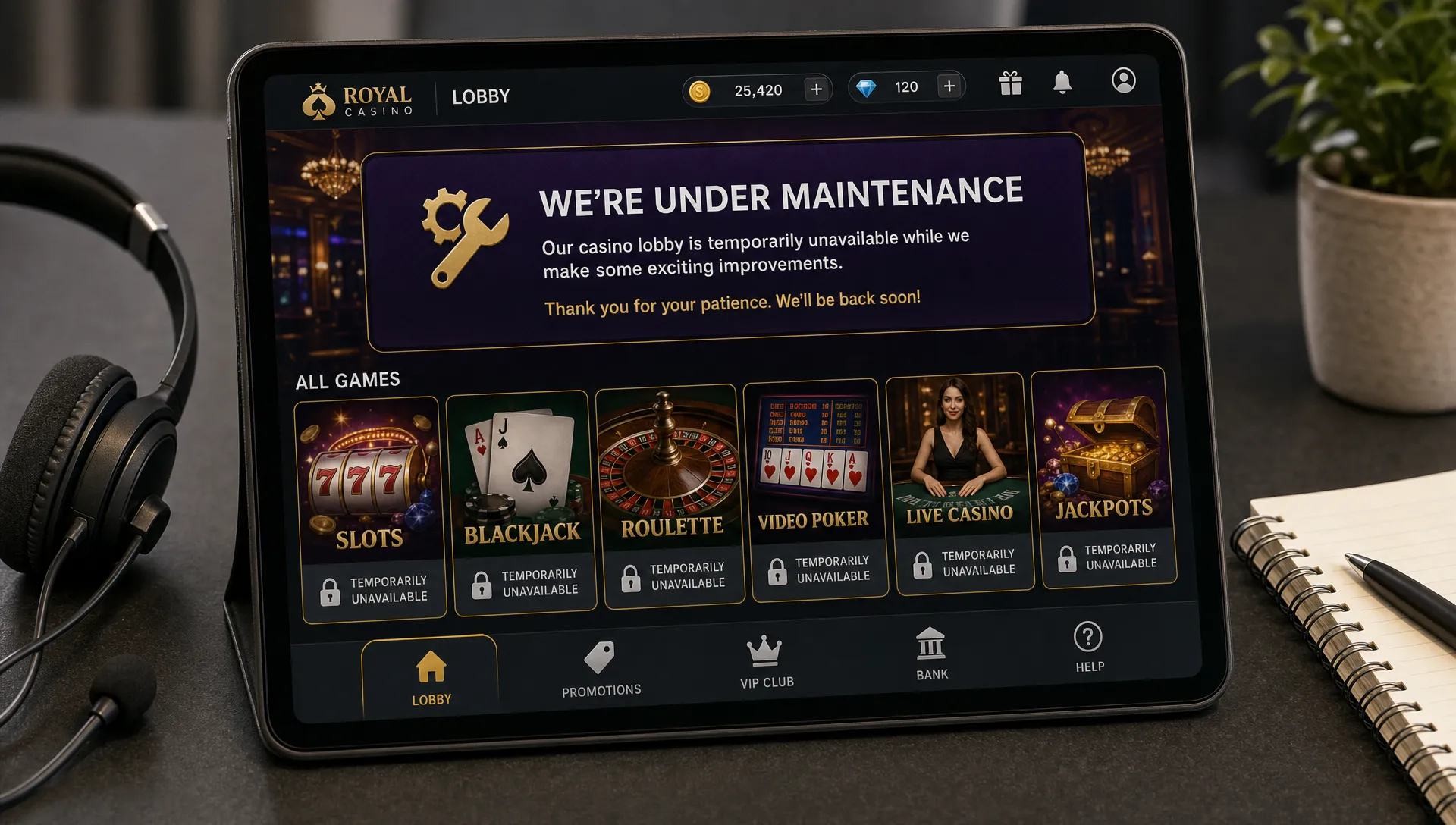
The game lobby is the highest-intent location. If a player is about to click an affected game, the message should appear before frustration happens. A tile label such as "Temporarily unavailable" is clearer than letting the game fail after launch.
For partial outages, avoid removing games without explanation. Sudden disappearance can make players think their account has a problem or that a promotion changed. A visible status label is usually more reassuring.
Site banner or account notification
Use a site banner when the impact is broader than a single game tile. Keep it short, factual, and linked to a fuller update if needed. The banner should not block critical account actions such as withdrawals, responsible gambling tools, or support access.
In-game modal
If a player is inside an affected game, a modal may be necessary. Use it carefully. It should not look like a promotional pop-up, and it should not pressure the player to keep trying. If the game session cannot continue, clearly tell the player whether the round result is being settled automatically or reviewed.
Push notifications and email
Push and email should be reserved for meaningful impact, such as planned maintenance, extended downtime, VIP-impacting incidents, or settlement follow-ups. Overusing push notifications for small interruptions can train players to ignore them. If your team uses push as part of incident messaging, the principles in these in-game push notification timing rules also apply to downtime updates.
Live chat and support macros
Support teams need the same facts players see, plus internal guidance. A public message that says one thing while live chat says another will increase mistrust. Give agents approved macros, escalation paths, and a clear list of things they should not promise.
Message templates for casino game downtime
Templates help operators move fast without sounding robotic. The best templates are short, specific, and easy to adapt.
Planned maintenance
Some games from [provider name] will be unavailable today from [time] to [time] while scheduled maintenance is completed. Your account balance and other games are not affected. We will update this notice when maintenance is complete.
Unplanned provider outage
We are currently investigating launch issues affecting selected games from [provider name]. Your account balance remains available, and we are checking any interrupted rounds against the provider records. Next update: [time].
Intermittent game loading issue
Some players may experience slow loading or failed launches on selected games. We recommend choosing another available game while we work with the provider to restore stable access. We will share the next update by [time].
Interrupted round or settlement review
If your round was interrupted, please avoid restarting the same game repeatedly. We are reviewing affected sessions and settlement records. If an adjustment is required, it will be handled according to the game rules and our terms.
Recovery message
The affected games are now available again and monitoring is ongoing. If you still see an error, refresh the lobby or contact support with the game name and approximate time of the issue. Thank you for your patience.
Be careful with compensation promises
Compensation can help repair trust, but only when handled consistently. During game downtime, operators should avoid promising free spins, bonus cash, refunds, or VIP credits before the impact is verified.
The safest approach is to separate reassurance from resolution. Reassurance tells players that balances, rounds, and eligible activity are being checked. Resolution happens after logs, provider records, and wallet data confirm what actually occurred.
A clear compensation policy should define:
- Which incidents qualify for manual review.
- Who can approve goodwill credits or bonus adjustments.
- How tournament, jackpot, or wagering progress is handled.
- How to document decisions for support and compliance.
- When to say no, especially if the player was not affected.
If compensation is offered, make it easy to understand. Players should not need to contact support three times to learn whether a bonus was restored or a failed round was settled.
Keep support aligned with operations
Downtime communication often fails because support receives information too late. Players contact live chat before the incident channel has a full update, so agents improvise. That creates inconsistent answers, screenshots on social media, and unnecessary escalations.
A better workflow is to give support a short internal incident card as soon as player impact is confirmed. It should include the incident name, affected games or providers, start time, current status, public message, next update time, escalation contact, and approved language for balance or bonus questions.
Support macros should be direct but human. For example:
I understand the concern, especially if you were in a round when the game stopped responding. The affected provider is currently being checked, and interrupted rounds are being reviewed against settlement records. Please share the game name and approximate time so we can attach it to your case.
Avoid blaming the provider in a way that sounds like the casino is avoiding responsibility. Players chose your online casino, not the supplier behind the game. It is fine to say a provider is affected, but ownership of the player experience remains with the operator.
Protect trust after the games come back
Resolution is not the end of communication. In fact, the period after recovery is when many players decide whether they still trust the brand.
A strong follow-up should include what was restored, what is still being reviewed, and what players should do if they believe they were affected. For serious incidents, it may also be worth sharing a brief post-incident note inside the help center or account message center.
Keep the tone factual. Do not over-apologize without substance, but do acknowledge disruption. If you make a mistake in an earlier update, correct it openly. A small correction is better than letting inaccurate information circulate.
Also, avoid sending aggressive promotions immediately after a serious downtime incident. If a player just had a failed game session or delayed settlement, a "deposit now" campaign can feel tone-deaf. Let the recovery message land first, then return to normal retention activity once the incident is closed.
Use downtime data to improve the next response
Every incident should improve the next one. After downtime, review not only technical recovery but also communication performance.
Useful questions include:
- How long did it take to publish the first player-facing message?
- Did support tickets spike before or after the first update?
- Which channel reduced confusion most effectively?
- Were players asking the same unanswered question repeatedly?
- Did any message create legal, compliance, or brand risk?
- Were affected games, bonuses, and settlements identified quickly enough?
This review should feed back into your iGaming platform operations. If lobby messages were too slow to publish, improve backoffice controls. If support did not know which games were affected, improve provider status tagging. If players kept asking about balances, make balance safety language clearer in the first update.
Downtime is never desirable, but it can become a useful stress test for your casino software provider, game aggregator setup, payment gateway dependencies, and internal communication process.
Frequently Asked Questions
How quickly should an online casino communicate game downtime? Communicate as soon as player impact is confirmed. For major incidents, aim to publish an initial message within minutes, then provide a clear next update time even if the root cause is still under investigation.
Should we message all players when only one game provider is down? Usually no. If only one provider or game group is affected, use targeted lobby, tile, or account messages where possible. Site-wide alerts should be reserved for broader issues that affect a large share of players.
What should we say if a player's round was interrupted? Tell the player that the session is being reviewed against settlement records, ask them not to repeatedly relaunch the affected game, and avoid promising a refund or bonus until the result is verified.
Is it a good idea to offer compensation after downtime? Sometimes, but compensation should follow a clear policy. Verify the player impact first, document the decision, and make sure any bonus or credit aligns with your terms and regulatory obligations.
Can downtime communication improve retention? Yes. Players are more likely to return when they feel informed and protected. Fast, specific, and honest updates reduce uncertainty, limit support friction, and show that the operator is in control.
Make downtime communication part of your casino platform
Casino game downtime cannot be eliminated completely, especially when operators depend on multiple providers, payments, wallets, and live services. But the player experience during downtime can be designed.
Spinlab helps operators build, launch, and scale online casinos with a modular iGaming platform that brings together game aggregation, crypto and fiat payment support, compliance tools, real-time analytics, and a customizable backoffice. If you want a more flexible way to manage casino operations without stitching every critical workflow together manually, explore Spinlab's white label casino platform.