

Casino refunds vs withdrawals is a distinction your payment team needs to get right before money leaves the business. A refund returns funds associated with an earlier payment. A withdrawal pays out an eligible player balance, which may include deposits and winnings. They can look identical to the player, but they require different transaction references, accounting entries and payment instructions.
Treating both as a generic “cash out” creates avoidable problems: rejected payments, duplicate returns, misleading support messages and reconciliation gaps. This guide explains how online casino operators can separate the two workflows while keeping policies clear and controls proportionate.
Casino refunds vs withdrawals: the core distinction
Classify the transaction by what it does, not by what the player calls it. A player asking to “refund my winnings” usually wants a withdrawal. Someone reporting a duplicate deposit may need a refund investigation.
| Transaction type | What it does | Main operational reference | Key constraint |
|---|---|---|---|
| Refund | Returns all or part of an earlier payment | Original payment and refund identifiers | Must follow the payment rail’s refund rules and refundable amount |
| Withdrawal | Pays an eligible account balance | Withdrawal request and payout identifiers | Requires available funds and an eligible payout destination |
| Authorization reversal | Releases an authorization before capture, where supported | Original authorization | Is not a refund of a captured payment |
| Chargeback or payment dispute | Challenges a payment through the issuer or payment scheme | Dispute case and original payment | Follows a separate evidence and liability process |
A withdrawal may use the same payment instrument as a deposit, but that does not make it a refund. Some card arrangements support separate payout transactions. Those transactions have their own rules and must not be disguised as purchase refunds.
Likewise, an authorization disappearing from a bank statement does not necessarily mean a refund occurred. The operator should identify whether the original payment was authorized, captured, reversed or refunded before explaining the outcome.
Write separate policies for payment errors and balance withdrawals
One broad “refund policy” rarely answers the questions players actually have. Your terms and help content should distinguish payment corrections, returns of unused deposits, withdrawals and disputed gambling activity.
Payment errors and unused deposits
Explain how players can report duplicate charges, incorrect amounts and deposits that never appeared in their casino wallet. A missing wallet credit is not automatically a refund case: the operator must first establish whether payment succeeded and whether the account was credited.
For unused deposits, state when a return can be requested, what checks apply and how the destination is determined. Do not promise universal eligibility or impose a blanket requirement to gamble before accessing deposited funds. Applicable law, licensing conditions and payment-provider rules must shape the policy.
A gambling loss is not automatically a refundable payment error. Allegations involving unauthorized activity, game malfunctions or regulatory failures need their own investigation rather than automatic approval or rejection under a generic refund rule.
Withdrawals, bonuses and restrictions
Define the withdrawable balance separately from promotional credit. Explain any lawful bonus conditions, verification requirements and payout limits before they become a support dispute.
Avoid language suggesting that every account restriction permits indefinite retention of all funds. Document the legal or contractual basis for a restriction and identify which amount it affects.
For a jurisdiction-specific reference, the UK Competition and Markets Authority’s online gambling investigation addresses unfair terms and restrictions on access to money. Operators serving other markets must assess their own applicable requirements rather than treating UK findings as a universal rule.
Build a refund workflow around the original payment
The distinguishing feature of a refund workflow is its connection to an earlier payment. That connection should survive every handoff between customer support, the casino ledger and the payment gateway.
Establish what happened before returning money
Start with the deposit identifier, provider reference, amount, currency and capture status. Then check whether the payment was credited, spent, previously refunded or disputed.
The same player complaint can produce different outcomes:
- Authorized but not captured: Release or reverse the authorization where supported, rather than creating a refund unnecessarily.
- Captured but not credited: Determine whether to repair the wallet credit or return the payment, preventing both actions from happening independently.
- Duplicate captured payment: Confirm that it is genuinely a duplicate and assess the corresponding wallet entries before refunding it.
- Existing refund or dispute: Investigate the current return path before sending another payment that could duplicate reimbursement.
Keep the original payment, wallet movements and investigation outcome linked. A support note saying “refund approved” is not enough to establish what happened to the player’s balance.
Reserve the amount and submit the correct instruction
Where funds have been credited and remain available, reserve the relevant amount before submitting the refund. Coordinate that reservation with the payment operation so the same funds cannot also be withdrawn or wagered.
If the funds are no longer available, route the case for a defined decision. Do not automatically manufacture a negative balance or treat a payment-error claim as an ordinary withdrawal.
Use the provider’s refund mechanism when appropriate, referencing the original payment and respecting its remaining refundable amount. If that mechanism is unavailable, any alternative return method needs a documented exception process covering ownership, compliance and accounting.
Your transaction receipts should preserve the references needed for disputes, including the original payment, refund amount, currency and status. Share a refund tracing reference with the player when the payment provider makes one available.
Distinguish submission from completion
A provider accepting a refund request is not necessarily confirmation that the player has received the money. Store the provider’s reported status and map it carefully to customer-facing language.
A useful internal lifecycle is requested, approved, reserved, submitted and then completed or failed. A timeout should create an uncertain state requiring investigation, not an automatic failure that triggers another payment.
Build a withdrawal workflow around the available balance
A withdrawal starts with the player’s entitlement to funds, not the refundable amount on a particular deposit.
Confirm eligibility and reserve funds
Calculate the available balance after accounting for pending bets, existing payout reservations and any valid restrictions. Keep cash, bonus credit and reserved funds distinguishable in the ledger.
Complete the verification and destination checks required for that transaction. Returning funds to a previously used method may be appropriate or required in some arrangements, but “return to source” is not a universal instruction that overrides every other consideration.
The destination must be supported for payouts, belong to the appropriate recipient and satisfy applicable requirements. A method that accepts deposits may not support withdrawals.
Execute once and handle uncertain outcomes safely
Reserve the withdrawal amount before dispatch, then associate the payout with a durable transaction identifier. Repeated clicks, duplicated callbacks and worker retries must not create additional transfers.
Use idempotency controls where the provider supports them. Before rerouting a payout to another provider or destination, establish that the first attempt did not pay and cannot subsequently complete.
A timeout is not proof of failure. If a transfer’s outcome remains unknown, keep the relevant reservation in place while checking provider records and settlement evidence. Release or finalize it only when the outcome is established.
This is where casino refunds vs withdrawals becomes a technical requirement rather than a wording choice: both need safe execution, but their transaction lineage and balance treatment differ.
Handle crypto returns as new transfers, not reversals
An on-chain transfer generally cannot be reversed by the casino after confirmation. Returning crypto usually means creating another transfer, even if the business classifies it internally as a refund.
Do not automatically send funds back to the address visible as the sender. It may belong to an exchange, a payment processor or another intermediary that cannot allocate the return to the player.
Verify the destination through an approved process and confirm the asset, network and any required memo or destination tag. Apply applicable sanctions screening, AML controls and transfer-information requirements. The process should also explain who bears network costs where charging them is lawful and permitted.
A fiat-to-crypto deposit introduces another distinction: the player may have purchased crypto through an onramp before funding the casino. Establish which entity processed each transaction and which leg is being returned. A casino wallet adjustment does not automatically reverse the onramp purchase.
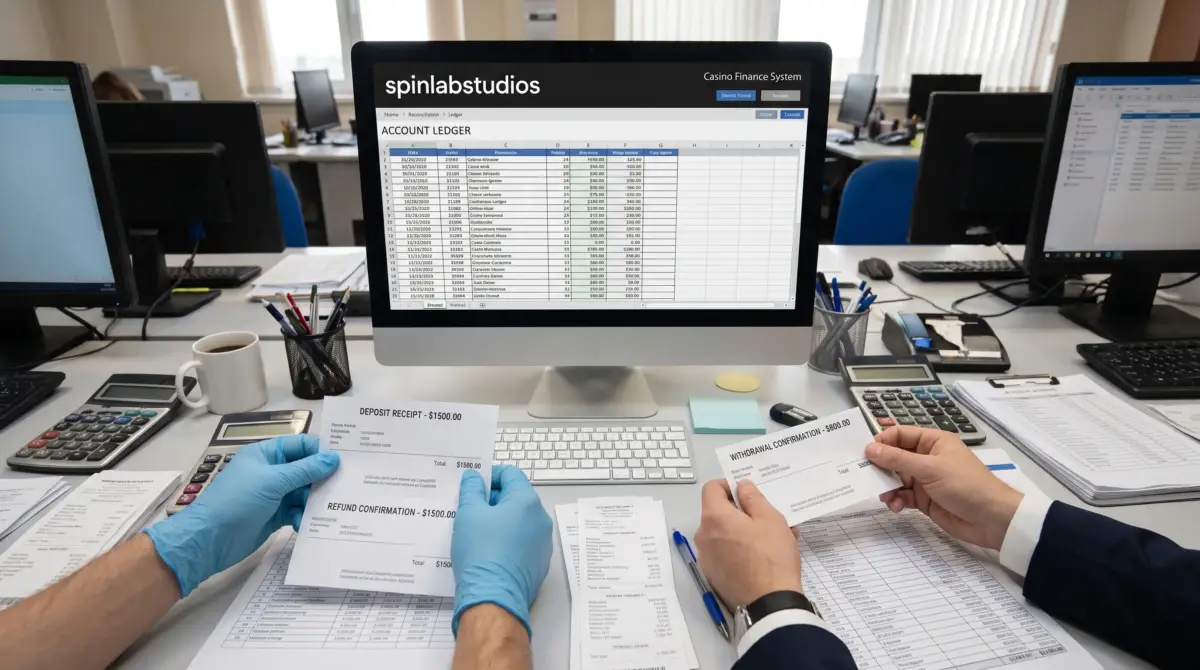
Worked example: the same deposit, two different outcomes
Suppose a player deposits $100 and the payment is captured and credited successfully. The following examples assume the stated transaction is permitted by applicable rules and the payment provider.
Returning an unused deposit
The player has not wagered and requests the full deposit back. After the required checks, the operator approves a refund through the original payment provider.
The system reserves the $100 balance, submits a refund linked to the deposit and finalizes the corresponding ledger adjustment once the outcome is established. The deposit record remains part of the audit trail; it is not deleted to make the account appear untouched.
Paying a balance that includes winnings
Instead, suppose the player wagers and now has a $140 eligible balance. A request to receive that money is a withdrawal.
The operator reserves $140 and sends a supported payout. It should not submit a $140 refund against a $100 deposit to deliver winnings. Any return of principal and separate payout must follow the provider’s permitted transaction types and produce clear ledger entries.
The practical lesson is simple: the original deposit amount does not define the player’s withdrawable balance, and the account balance does not define the refundable amount of a payment.
Give players timelines that match the payment lifecycle
Publish separate expectations for internal review and external processing. “Approved” should mean the operator has approved the transaction, not that the receiving bank has credited it.
For both workflows, distinguish the request time, approval time, provider submission time and confirmed completion time. Explain which stage the player is waiting on and whether any action is required from them.
Avoid promising one universal completion time across cards, bank transfers, wallets and crypto networks. Provider processing, banking schedules and network conditions differ. Where an estimate is available, identify what it covers and what can change it.
If a case exceeds the stated review window, provide a revised update rather than repeatedly sending the original estimate. When a player challenges the decision itself, move the case into a documented complaints resolution workflow instead of leaving it in an indefinite payment queue.
Reconcile refunds and payouts without losing their differences
Both transaction types move money out, but combining them into one reporting category hides operational problems. Finance should be able to distinguish payment corrections from withdrawals and identify the original transaction where one exists.
Reconcile the internal ledger against provider records and the relevant bank or wallet movements. The mechanics of matching casino ledgers, payment providers and bank records are especially useful when a provider’s status and the operator’s balance disagree.
Record principal amounts, fees and currency conversion separately. If the player sees a different amount in their bank account, support should be able to establish whether the difference came from the operator, provider, bank or exchange rate rather than guessing.
Useful operational measures include refund completion time, withdrawal completion time, unresolved payment states, duplicate-return incidents and reconciliation exceptions. Measure internal approval time separately from external settlement time so a fast approval does not conceal a slow payment route.
Frequently asked questions
Can a casino refund winnings to a card? A purchase refund should not be used to disguise a payout of winnings. Some card arrangements support separate payout transactions, subject to provider, scheme and jurisdictional requirements.
Does a refund always go back to the original payment method? Many refund mechanisms are tied to the original payment. If that route is unavailable, an alternative requires a controlled process consistent with applicable rules. An expired or replaced card alone does not prove the provider cannot route a refund.
Can a player receive a refund and a chargeback for the same deposit? Both processes can overlap operationally, creating a duplicate reimbursement risk. Link the dispute and refund records, check current statuses and coordinate with the provider before taking further action.
Is a crypto refund instant? No. Internal approval, destination verification, broadcast and network confirmation are separate stages. A completed outgoing transfer is also different from confirmation that an exchange has credited the player’s account.
Evaluate the platform behind the policy
Clear policies need a payment architecture that can enforce them. When evaluating Spinlab’s modular iGaming platform, discuss how your required refund and withdrawal workflows would connect with its fiat and crypto payment support, customizable backoffice, KYC and AML capabilities and fraud prevention.
Ask to walk through a duplicate deposit, a partial refund, an uncertain payout and a crypto return. Confirm transaction identifiers, balance reservations, permissions and reconciliation responsibilities for each integration before launch.
