

Most casino game round disputes start with a simple player statement: “my spin froze,” “my win did not credit,” or “the dealer result is wrong.” Fair handling means more than deciding whether to refund. For casino game round disputes, operators need a repeatable process that preserves evidence, compares the game outcome with wallet movements and explains the decision in language a player can understand.
Why game round disputes deserve their own process
A round dispute is not the same as a failed deposit, a delayed withdrawal or a general service complaint. It sits at the intersection of the game server, game aggregator, casino wallet, bonus engine, device session and support team. If any one of those systems uses vague identifiers or overwrites state, the investigation becomes guesswork.
For an online casino, the goal is not to “win” the dispute against the player. The goal is to reconstruct what happened, apply the rules consistently and leave an audit trail strong enough for internal review, provider escalation or regulator questions.
Game round disputes also affect trust quickly. A missing win feels personal to the player, especially in slot games or live casino games where the player watched the action unfold in real time. A fair process reduces unnecessary goodwill credits, prevents inconsistent decisions and protects the integrity of the iGaming platform.
What a fair process should prove
A good review answers four practical questions: did the round exist, what result did the certified game system record, did the wallet reflect that result and did any bonus or risk rule change the settlement?
| Fairness principle | What it means in practice | What to avoid |
|---|---|---|
| Evidence first | Preserve logs before adjusting balances | Refunding immediately without checking the round |
| Consistency | Apply the same policy to new players, VIPs and affiliates | Making exceptions based only on player value |
| Proportionality | Match the remedy to the actual failure | Paying a claimed jackpot without provider confirmation |
| Explainability | Give the player a clear reason and next step | Sending a vague “technical issue” response |
Common types of casino game round disputes
Most cases fall into a few predictable patterns. Categorizing the dispute early helps support teams ask for the right evidence and prevents a simple wallet mismatch from becoming a full fraud review.
| Dispute type | Typical player claim | Evidence to check first |
|---|---|---|
| Frozen or interrupted round | “The spin stopped and my balance changed” | Round ID, game state, wallet debit and settlement event |
| Missing win | “I won but the money never arrived” | Provider result, payout multiplier, wallet credit and bonus wallet logic |
| Duplicate debit | “I was charged twice for one spin” | Idempotency keys, wallet entries, client retries and provider callbacks |
| Live dealer interruption | “The stream disconnected during the hand” | Dealer result, seat state, disconnection timing and table rules |
| Outcome mismatch | “The screen showed one result but history shows another” | Client display logs, server result and replay or audit record |
| Bonus settlement conflict | “My real balance should have increased” | Bonus terms, wagering contribution, wallet priority and round timestamp |
This table is also useful for training. Support agents should not need to know every game mechanic, but they should recognize whether the complaint is about display, settlement, bonus treatment or payment flow.
Build the evidence pack before deciding
The strongest round dispute workflow begins before a complaint arrives. Every completed, canceled or failed round should leave a trace that can be found by round ID, player ID, session ID and wallet transaction ID.
The casino ledger matters because balance views alone are not enough. A balance is a snapshot. A ledger explains how the balance changed. If your team struggles to reconstruct debits, credits, reversals and settlements, a better casino ledger design for audit trails and reversals will make game dispute decisions faster and more defensible.
The minimum evidence set
A complete case file should include records from each system that touched the round. If the casino operates original games, the internal game service should provide the same level of evidence that an external studio would provide.
| Evidence layer | Records to preserve | Why it matters |
|---|---|---|
| Player session | Login time, IP, device, browser or app version | Confirms the player context during the round |
| Game system | Round ID, game ID, stake, result, status and provider timestamp | Establishes the recorded game outcome |
| Wallet ledger | Debit, credit, reversal, balance before and balance after | Shows whether money moved correctly |
| Bonus engine | Bonus wallet used, wagering status and restricted play rules | Explains bonus-related settlement differences |
| Aggregator or provider | Callback payloads, retry logs, signatures and error codes | Confirms what the game aggregator or studio sent |
| Support record | Player statement, screenshots and communication timeline | Shows how the casino handled the complaint |
One case ID, many source IDs
Each dispute should receive a single case ID that links every related identifier. Do not force agents to search separately by payment transaction, game round, wallet movement and chat transcript. A good backoffice admin panel should let teams move from one identifier to another without losing context.
This is especially important for operators using a white label casino platform with several studios, a payment gateway, crypto onramp support and multiple wallet types. The more modular the stack, the more disciplined the identifier strategy must be.
Preserve logs before anyone edits the balance
Manual balance changes are sometimes necessary, but they should never erase the original sequence of events. Use append-only adjustments, record the reason code and require a second review for high-value claims.
Time consistency matters too. Store timestamps in UTC, keep provider timestamps visible and note any clock drift if systems disagree. If a player says the round happened “after” a deposit or bonus activation, timestamp accuracy may decide the case.
Triage without making the player feel accused
Triage should protect the player experience and the casino. The first response should acknowledge the complaint, capture the round details and explain that the team will compare provider and wallet records.
Do not accuse the player of misunderstanding the game. Many genuine disputes come from lag, mobile network drops, game client refreshes or provider callback delays. At the same time, support should avoid promising a refund before the result is confirmed.
| Triage level | When to use it | Operational action |
|---|---|---|
| Simple review | Low stake, clear round ID, normal account history | Support checks game history and wallet entries |
| Provider review | Missing settlement, unclear result or aggregator error | Escalate with a structured evidence pack |
| Risk review | Repeated disputes, device anomalies or suspicious patterns | Involve fraud or risk without delaying basic evidence preservation |
| Incident review | Multiple players affected by the same game or provider | Treat as a platform incident and notify product, support and compliance |
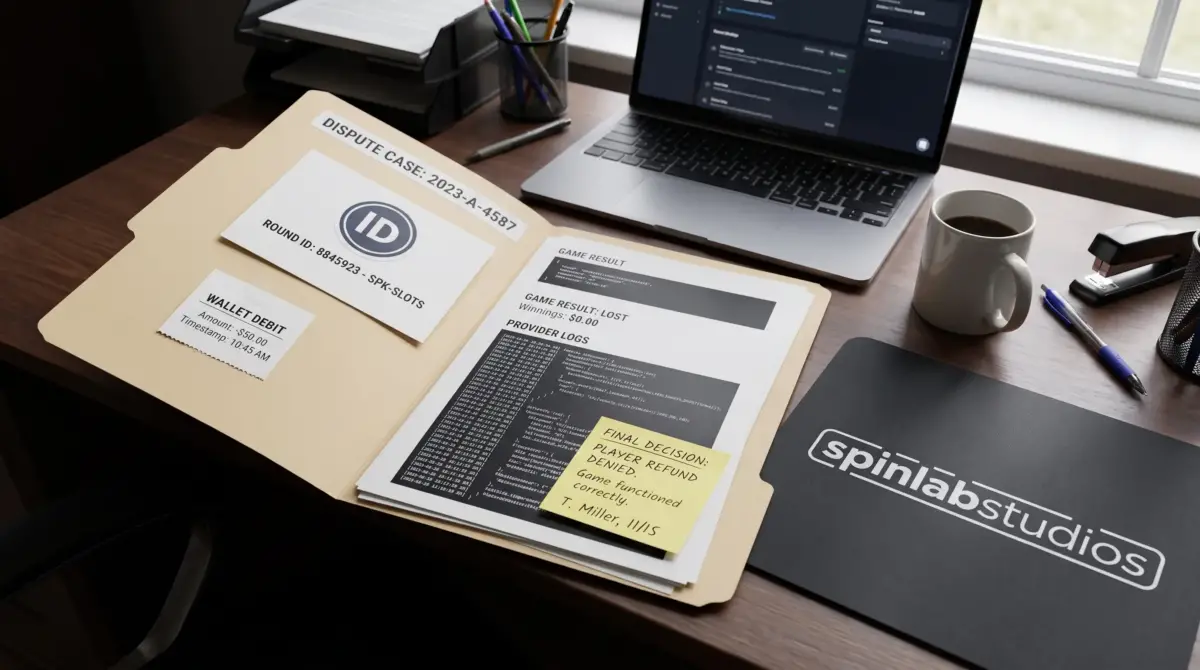
How to investigate casino game round disputes
A fair investigation follows the same order every time. If the team jumps straight to player screenshots or goodwill credits, it may miss the actual cause of the mismatch.
Verify the round exists
Start by confirming the disputed round in the game history or provider backoffice. If there is no round ID, use time, game title, stake size and session ID to narrow the search. Screenshots can help locate a round, but they should not replace server records.
If the game supports replay or detailed round history, attach it to the case. For live casino games, confirm the table, seat, dealer round and final result recorded by the provider.
Compare game result with wallet movement
Next, compare the game result to wallet activity. A clean case usually has a stake debit, final result and matching credit or loss settlement. A disputed case may show a debit without a final result, a provider win without wallet credit or a retry that created duplicate wallet activity.
Use balance before and balance after only as supporting context. The ledger entries are the real evidence.
Ask providers precise questions
Provider escalations should be specific. Instead of asking “what happened with this player,” send the round ID, game ID, timestamp, player pseudonymous ID, stake, currency, wallet entries and exact issue.
The best questions are narrow: was the round completed, voided or canceled? What final result did the provider record? Were callbacks delivered successfully? Did the game rules allow the result to stand after disconnection?
Write the decision as an audit note
The final decision should be written as if another team will review it later. Include the evidence checked, the result, the remedy and the reason. Avoid shorthand such as “player wrong” or “provider issue.” Those notes create risk when a case is escalated.
A clear audit note might say: “Round 98765 was completed by the provider at 20:14:32 UTC with a loss result. Wallet debit of 10 USDT posted at 20:14:31 UTC. No credit was due. No adjustment made.”
Coordinate with the game aggregator and studios
A game aggregator simplifies content delivery, but it also adds another layer to dispute handling. The casino may receive game history through the aggregator while the final certified record sits with the studio. Your operating model should define who answers which questions and how quickly.
Before launching new slot games, live tables or casino original games, test round-state callbacks in failure scenarios. Simulate slow responses, mobile refreshes, duplicate callback retries and temporary wallet unavailability. A smooth launch is not enough. The dispute path must work too.
Contracts and integration documents should cover log retention, support escalation channels, replay availability, voiding rules, settlement status codes and timezone format. If those details are missing, your support team will discover the gap during the worst possible moment, when a player is angry and a high-value claim is open.
Choose a remedy that matches the failure
A fair outcome is not always a refund. The remedy should match what the evidence proves. Overpaying unverified claims creates abuse incentives, while rejecting valid claims damages trust and may trigger public complaints or payment disputes.
| Finding | Fair remedy | Notes |
|---|---|---|
| Debit posted, no valid round created | Refund the stake | Explain that the wager was not completed |
| Provider recorded win, wallet credit missing | Credit the correct winnings | Attach provider confirmation to the case |
| Provider recorded loss and wallet matches | No balance adjustment | Explain the evidence clearly and offer review path |
| Duplicate debit for one completed round | Reverse the duplicate debit | Keep both original entries visible in the ledger |
| Provider voided round under game rules | Apply void or refund policy | Reference the applicable game or provider rule |
| Display error, server result valid | Usually no payout adjustment | Consider goodwill only under a documented policy |
Goodwill credits need controls. They can be useful for low-value service recovery, but they should not be labeled as confirmed winnings unless the evidence supports that conclusion.
Communicate the outcome clearly
Players do not need a database dump. They need a clear answer that shows the casino checked the right records. A good message names the game, date, stake, outcome and adjustment decision without exposing internal fraud rules or sensitive provider data.
For complex complaints, use the same structure every time: acknowledge the issue, summarize the evidence, state the decision and explain the escalation option. If your casino receives many complaint types, a broader casino player complaints workflow can sit above the round-specific process and route cases to the right team.
A concise response can sound like this:
Thanks for waiting while we reviewed your game round. We checked the provider record and wallet ledger for the round played on September 30 at 20:14 UTC. The provider recorded the round as completed with a loss result and the wallet shows one matching stake debit. Based on those records, no balance adjustment is due. If you believe a different round is affected, please send the game name, approximate time and stake so we can review it.
That response is firm, but it is not dismissive. When the casino does make an adjustment, the message should be equally specific: what was credited, why and when it became visible in the balance.
Keep payment, bonus and fraud reviews connected but separate
Round disputes often touch payment operations, but they should not be merged with every payment issue. A player who lost a round may later file a chargeback through a card issuer or complain that a crypto deposit was used before a disputed game completed. The teams should share evidence, yet the decision logic is different.
Payment gateway records prove deposit authorization and settlement. Game records prove the wager result. Bonus records prove whether a win was withdrawable, locked or subject to wagering. Fraud records may explain why an account is under review, but they should not be used as a shortcut to reject a valid game settlement issue.
For crypto-ready casinos, be precise about wallet types and asset movements. A blockchain transaction may prove that funds arrived at the casino wallet, but it does not prove whether a specific game round settled correctly. Keep crypto onramp evidence, merchant custodial wallet records and game ledger entries linked without treating them as the same thing.
Prevention: design for fewer disputes
The cheapest dispute is the one that never reaches support. Product and engineering teams can reduce round disputes by making state changes deterministic, visible and recoverable.
Strong prevention practices include:
- Use idempotency keys so retries do not create duplicate debits.
- Show game history that players can understand, including stake, result and time.
- Alert operations when provider callbacks fail or settlement queues grow.
- Keep bonus wallet rules visible to support agents during case review.
- Test mobile interruptions, app refreshes and network drops before major game launches.
Real-time analytics can also reveal patterns. If one game, studio, jurisdiction, device type or currency produces unusual dispute volume, treat it as a product signal rather than a support annoyance.
After a cluster of disputes, run a short incident review. Focus on the timeline, system behavior, customer impact and prevention changes. Avoid blame. The practical question is how the casino can make the next case easier to prove and faster to resolve.
Compliance and record retention in 2026
Licensing requirements vary by market, but the direction is consistent: casinos need reliable records, fair game operation and clear handling of complaints. The UK Gambling Commission remote gambling and software technical standards and the GLI standards for interactive gaming systems are useful reference points for understanding how regulators and testing labs think about system integrity.
Do not treat this article as legal advice. Operators should align their policies with their license conditions, local complaint rules and provider contracts. Still, the operational foundation is the same in most regulated markets: preserve the record, apply published rules and document the decision.
Retention policies should cover completed rounds, failed rounds, voided rounds, wallet movements, bonus decisions, chat transcripts and provider escalation responses. Access should be limited to staff who need it, and every manual adjustment should be attributable to a named user or service account.
Frequently Asked Questions
What is a casino game round dispute? A casino game round dispute is a player complaint about a specific wager or game event, such as a frozen spin, missing win, duplicate debit, live dealer disconnection or mismatch between the displayed result and wallet balance.
Who is the source of truth, the casino or the game provider? The provider or certified game system is usually the source of truth for the game result, while the casino wallet or ledger is the source of truth for balance movements. A fair review compares both records.
Should a casino refund a player if their connection drops? Not automatically. The operator should check the game rules and provider record. Some rounds continue to settlement on the server even if the player disconnects, while others may be voided depending on the game type and rules.
How fast should round disputes be resolved? Simple cases can often be resolved by support once the round and wallet entries are visible. Cases requiring provider review take longer, so the casino should give the player a realistic update schedule rather than a vague promise.
How can a white label casino platform reduce round disputes? A strong white label casino platform should make round IDs, wallet entries, bonus rules, provider callbacks and support notes easy to connect in one backoffice workflow. That reduces investigation time and improves consistency.
Build fair round dispute handling into your casino stack
Fair dispute handling is much easier when the platform is designed for it from day one. Spinlab offers a modular, all-in-one iGaming platform for launching and scaling online casinos with game aggregation, crypto and fiat payment support, real-time analytics, compliance tooling and a customizable backoffice.
If you are building a whitelabel casino or upgrading an existing online gambling platform, make dispute evidence part of the core product requirements. Players notice fast resolutions, regulators expect clean records and your team will thank you every time a disputed round can be resolved from facts instead of guesswork.
