

A multilingual casino can have well-translated pages and still show the wrong regional version in search. Implementing hreflang for casino websites helps Google understand which URLs serve different languages and markets, whether you operate on subfolders, subdomains or separate domains. The implementation depends on more than adding language codes: equivalent pages must be mapped correctly, annotations must agree and canonical signals must support the intended structure.
This tutorial walks through a practical setup, including a reusable locale map, implementation options and checks for regional game availability, redirects and indexing.
What hreflang does, and what it does not
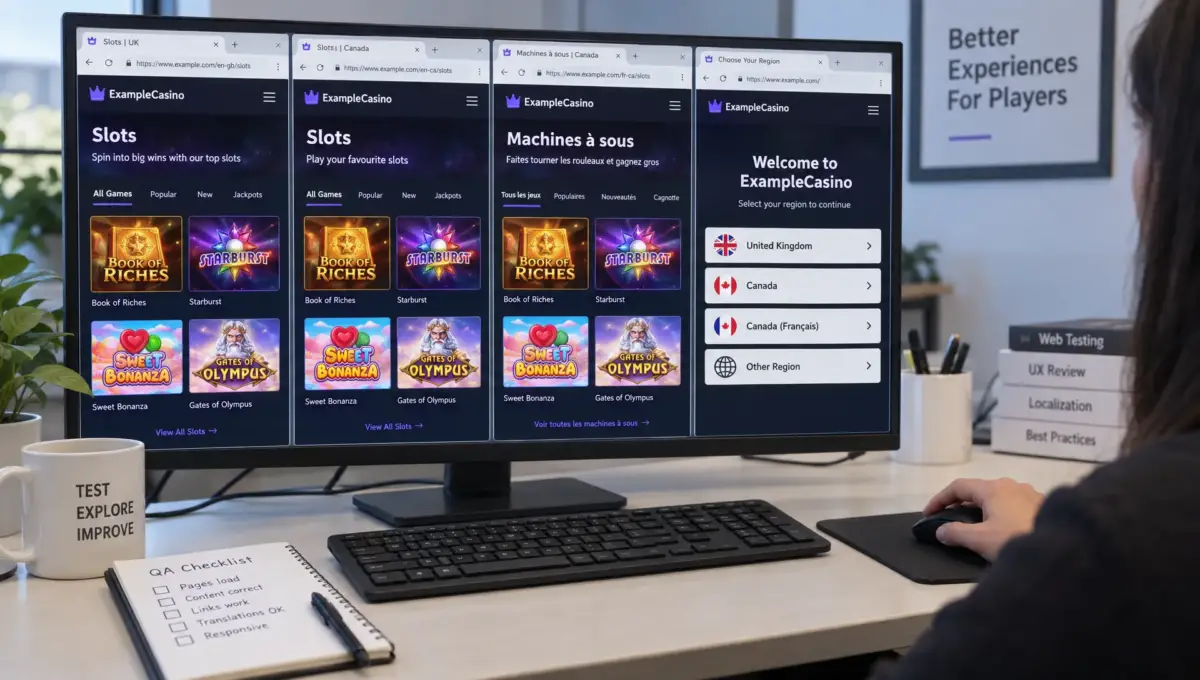
Hreflang identifies alternate language or regional versions of a page. For example, it can connect an English slots category for Canadian users with its French Canadian equivalent and an English version intended for the United Kingdom.
Google can use those relationships to surface the appropriate URL. As Google's localized-version documentation explains, annotations need supported language codes, complete URLs and reciprocal relationships between alternate pages.
Hreflang is not an access-control mechanism. It does not enforce licensing restrictions, verify player location or determine whether someone can legally register. Those decisions belong in your compliance and access-control systems.
It also does not translate content, guarantee indexing or automatically improve rankings. Its purpose is to clarify relationships between existing localized pages, not to compensate for weak content or an inaccessible website.
1. Map equivalent pages before adding annotations
Start with a page-level inventory, not a list of languages in your navigation. Every group of alternate URLs, often called a cluster, should represent the same underlying page or user task.
Here is an illustrative cluster using the reserved example domain casino.example:
| Hreflang value | URL path | Intended page |
|---|---|---|
en-GB |
/en-gb/games/slots/ |
English slots category for UK users |
en-CA |
/en-ca/games/slots/ |
English slots category for Canadian users |
fr-CA |
/fr-ca/jeux/machines-a-sous/ |
French slots category for Canadian users |
x-default |
/choose-region/slots/ |
Market selector preserving the slots destination |
These market labels are examples, not statements about licensing eligibility. Country-level hreflang cannot distinguish provinces, states or other subnational regulatory boundaries.
For an existing site, connect this inventory to your broader casino SEO strategy so that URL architecture and market priorities are decided together.
Match page purpose, not just URL patterns
An English deposit guide and a French homepage are not equivalents. Neither are two game pages that happen to occupy the same position in separate navigation menus.
For category pages, regional game inventories can differ while the pages still serve the same purpose. An English slots category and its French equivalent may remain valid alternates even when individual titles are unavailable in one market. The relationship should still make sense to a visitor switching languages.
A consistent approach to casino category-page structure makes these relationships easier to maintain as your catalogue grows.
Use supported language and country codes
Use a language code first, optionally followed by a country code. A hyphen separates them: fr-CA, not fr_CA.
| Value | Meaning or issue |
|---|---|
en |
English without a country restriction in the annotation |
en-GB |
English targeting the United Kingdom |
fr-CA |
French targeting Canada |
en-UK |
Incorrect country code for this purpose; use en-GB |
en-EU |
Not a supported country target for Google hreflang |
x-default |
Fallback when no listed language or region is the appropriate match |
Currency codes do not belong in hreflang. A page showing Canadian dollars does not automatically deserve en-CA; its language, intended audience and actual content must support that designation.
2. Build one source of truth for locale relationships
Avoid maintaining alternate URLs independently inside every template. A shared mapping reduces the risk that an English page points to French while the French page points somewhere else.
For example, your CMS or application could store this configuration:
{
  "page_id": "slots-category",
  "alternates": {
    "en-GB": "https://casino.example/en-gb/games/slots/",
    "en-CA": "https://casino.example/en-ca/games/slots/",
    "fr-CA": "https://casino.example/fr-ca/jeux/machines-a-sous/",
    "x-default": "https://casino.example/choose-region/slots/"
  }
}
This is an illustrative data model, not a platform-specific feature. Your implementation can use database records, CMS fields or a routing configuration.
Store a stable page identifier separately from translated slugs. If the French slug changes, the page relationship should survive without anyone having to rediscover it manually.
Generate each participating page's annotations from the same map. Include the page itself, not just its alternates. A complete cluster therefore gives every member the same list of language and regional relationships.
3. Choose one hreflang implementation method
Google supports three methods. Choose the one your team can generate accurately and test consistently.
| Method | Where annotations live | Practical fit |
|---|---|---|
| HTML head | Alternate link elements in each page's document head | Teams controlling server-rendered page templates |
| HTTP headers | Link response headers |
Teams controlling application or edge responses, including non-HTML resources |
| XML sitemap | Language alternates attached to sitemap URL entries | Sites managing large URL inventories through sitemap generation |
You do not need all three. Google treats these methods as equivalent, and maintaining several implementations creates more opportunities for conflicting data.
HTML-head implementation
For each mapping entry, generate a link element with rel set to alternate, hreflang set to the locale key and href set to the fully qualified alternate URL.
Place those elements inside a valid document head. Each localized page needs its own reference plus references to the other members of its cluster.
Prefer server-generated annotations that are available in the initial HTML response. They are easier to inspect and less dependent on client-side execution. Do not make the alternate list change according to the visitor's IP address or browser language.
Use complete URLs, including the protocol and hostname. This matters especially when alternates live on different domains.
Worked HTTP-header example
If you control response headers, the sample cluster can be expressed as repeated Link headers:
Link: <https://casino.example/en-gb/games/slots/>; rel="alternate"; hreflang="en-GB"
Link: <https://casino.example/en-ca/games/slots/>; rel="alternate"; hreflang="en-CA"
Link: <https://casino.example/fr-ca/jeux/machines-a-sous/>; rel="alternate"; hreflang="fr-CA"
Link: <https://casino.example/choose-region/slots/>; rel="alternate"; hreflang="x-default"
Return this complete set on every participating URL, including the selector in this example. Configure the application, reverse proxy or CDN so that the headers survive caching and deployment.
A basic response check is:
curl -sS -D - -o /dev/null https://casino.example/fr-ca/jeux/machines-a-sous/
This makes a GET request and prints the response headers. Verify the status code and confirm that the expected Link headers are present. Repeat the check for the other cluster members.
XML-sitemap implementation
If you choose sitemaps, include each localized URL as its own URL entry. Under each entry, provide the complete alternate set, including that entry's own language version, using Google's documented XHTML link-extension format.
Keep normal sitemap scope and ownership requirements in mind, particularly when alternate URLs span domains. Hreflang can connect pages across domains, but it does not remove sitemap hosting rules.
Generate sitemap relationships from the same page map used elsewhere in your system. Do not infer equivalence merely by replacing a language folder in a URL.
4. Align hreflang with canonicals and routing
Hreflang describes alternate versions. Canonical annotations identify a preferred representative for duplicate or substantially similar URLs. They solve different problems.
For a localized page intended to remain independently indexed, a self-referencing canonical is usually the appropriate starting point. Do not automatically canonicalize every translation to the English page. That asks Google to consolidate URLs you are also presenting as distinct language alternatives.
Google's canonicalization guidance recommends choosing a canonical in the same language when using hreflang, where possible. Deliberately consolidating same-language regional duplicates is a separate decision that needs careful testing rather than a blanket rule.
Also use final destination URLs in your alternate map. If an old French slug redirects to a new one, update the annotations instead of leaving Google to follow the redirect on every crawl.
Use x-default deliberately
x-default is optional. A market or language selector is a useful destination when none of the specified versions is appropriate.
A page-aware selector can preserve the visitor's intended task. Someone arriving for a slots category should be able to choose a market and continue to the corresponding category rather than restart from the homepage.
A general selector can still be used, but make that a conscious user-experience decision. The fallback is not an instruction to ignore your other annotations, nor does it replace a language-only value such as en when you have a genuine general-English version.
Keep geolocation separate from language selection
Avoid automatically sending every visitor to a different URL based solely on IP address or browser language. Forced routing can prevent users and crawlers from reaching the version they requested.
Where lawful and appropriate, offer a market suggestion while keeping locale URLs accessible. Google describes the crawling limitations of locale-adaptive delivery in its guidance for multi-regional websites.
Legally required restrictions still take precedence. Test the actual response behavior rather than assuming that hreflang makes a restricted page discoverable or accessible.
5. Handle missing translations and restricted games
Casino catalogues change frequently. Provider agreements, certification requirements and market restrictions can leave one locale without an equivalent game page.
Do not invent an alternate just to complete the cluster. If a game has no legitimate French Canadian page, omit that version from the game's alternate map. The remaining equivalent pages should reference one another consistently.
Do not substitute a homepage, unrelated slot or unavailable-game message simply because it returns a successful status code. A technically reachable URL is not necessarily an equivalent destination.
For an unpublished translation, wait until the page is live, accessible and ready for indexing before adding it. For a permanently removed page, remove its references from the remaining cluster members as part of the retirement workflow.
The same principle applies to promotions. Two bonus pages with different eligibility conditions may be regional equivalents if they fulfil the same underlying purpose, but an unrelated campaign should not be connected merely because both URLs contain the word “bonus.”
6. Validate clusters before and after launch
Testing individual tags is not enough. Hreflang works through relationships, so the audit needs to compare pages with one another.
Check crawlability and indexability
For each alternate URL, confirm that it returns the intended content with a successful response, is not marked noindex and can be crawled by Google.
Check both HTML directives and HTTP response headers. An application can output correct alternate links while a CDN adds an indexing restriction or redirects requests to a market gate.
Test representative templates, including category pages, individual games, payment guides and responsible-gambling content. Different templates often use different rendering or routing logic.
Check reciprocal links and canonical alignment
A crawler such as Screaming Frog or Sitebulb can help identify missing return links, invalid codes, redirecting destinations and conflicting annotations.
Use a short acceptance checklist:
- Every alternate points to the correct equivalent page using its final, fully qualified URL.
- Every participating page includes itself and the agreed alternate set.
- Return links exist between the alternate pages.
- Language codes are supported and no locale key points to conflicting destinations within a cluster.
- Canonical and indexing signals support the intended treatment of each URL.
Duplicate language assignments deserve manual review. Two different URLs both labeled fr-CA in the same cluster usually indicate a mapping error, whereas one URL serving more than one appropriate language-region label can be intentional.
Monitor Google without expecting a dedicated hreflang report
Google Search Console no longer provides the old International Targeting report. Use URL Inspection to investigate selected pages' indexing and canonical status, but do not treat it as a complete cluster validator.
In Performance reports, compare landing pages by country to investigate whether the wrong regional URLs continue receiving impressions or clicks. Country data is useful evidence, not a direct report of the searcher's language or proof that an annotation was accepted.
After deployment, allow time for affected pages to be recrawled. Keep a record of mapping changes so you can distinguish a technical regression from shifts in demand, content or availability.
Frequently asked questions
Does every casino page need hreflang? No. Use it where equivalent language or regional versions exist. A page available in only one version does not need an invented alternate.
Can alternate pages use different domains? Yes. Hreflang can connect subfolders, subdomains and separate domains. The relationships still need complete URLs, return annotations and accessible destinations.
Can hreflang target Ontario rather than Canada? No. Google's regional targeting uses country codes, not province or state codes. Provincial eligibility requires separate compliance and access-control logic.
Should every page link to every language on the website? No. It should reference its own equivalent versions, not every language homepage. Include only locales with an appropriate counterpart for that page.
Does hreflang guarantee the correct regional URL will rank? No. It helps Google interpret alternate versions, but indexing, canonical selection, relevance and other search signals still affect which URL appears.
Make locale management part of platform evaluation
Before expanding a multilingual casino, confirm who owns the locale map, how alternate URLs are generated and what happens when a game or translation is removed. These operational details matter more than a one-time tag insertion.
When evaluating Spinlab's modular iGaming platform, include locale routing, canonical controls and hreflang generation in your technical requirements. Ask how your intended implementation would be supported and validated before launch rather than assuming multilingual SEO is automatic.
