

White label casino pricing looks simple until you start adding the parts that actually make an online casino run: games, payments, compliance, fraud controls, hosting, and ongoing operations. In 2026, the “platform fee” is rarely the real number you end up paying.
This guide breaks down what you really pay for a white label casino in 2026, how vendors structure pricing, where hidden costs show up, and how to model total cost of ownership (TCO) before you sign.
Why white label casino pricing is harder in 2026
Two trends are making pricing less comparable than it used to be:
First, platforms are bundling more critical infrastructure (KYC/AML, risk rules, analytics, payment orchestration, multi-currency walleting). That’s good for speed, but it also means vendors can hide margin across modules.
Second, regulatory and payments complexity is rising, especially if you touch crypto, operate across jurisdictions, or need audit-grade logging. If you are operating in Europe, staying current on changes like PSD3/PSR (payments) and MiCA-related expectations for crypto flows can add real implementation and vendor costs over time. (Spinlab has deeper explainers on PSD3 and PSR for iGaming payments and MiCA stablecoin rules.)
The 4 most common white label pricing models (and what they incentivize)
Most casino software providers use one (or a hybrid) of these models:
| Pricing model | How it’s billed | Best for | What to watch for |
|---|---|---|---|
| Fixed monthly platform fee | Flat subscription | Predictable budgeting, steady growth | Vendors often unbundle key modules later (payments, KYC, analytics, extra brands) |
| Revenue share (percentage of GGR or NGR) | Vendor takes a cut of revenue | Low upfront cash, early-stage launches | Misaligned incentives on cost control, increases with success |
| Hybrid (base fee + rev share) | Smaller fixed fee plus % cut | Balancing runway and alignment | Complex contract definitions (GGR vs NGR, deductions, carryover rules) |
| Per-module or per-operator “menu” pricing | Pay for components you enable | Operators who know their stack well | Death by add-ons, integration and support fees multiply |
What you want as an operator: pricing that is transparent, scalable, and contractually clear on what is included versus billable later. If you are still comparing approaches, see White Label vs Custom Casino: How to Choose and the cost dynamics in Multi-Tenant vs Single-Tenant Casino Platforms: Pros, Cons, and Cost Models.
The real cost stack: what you pay beyond “the platform”
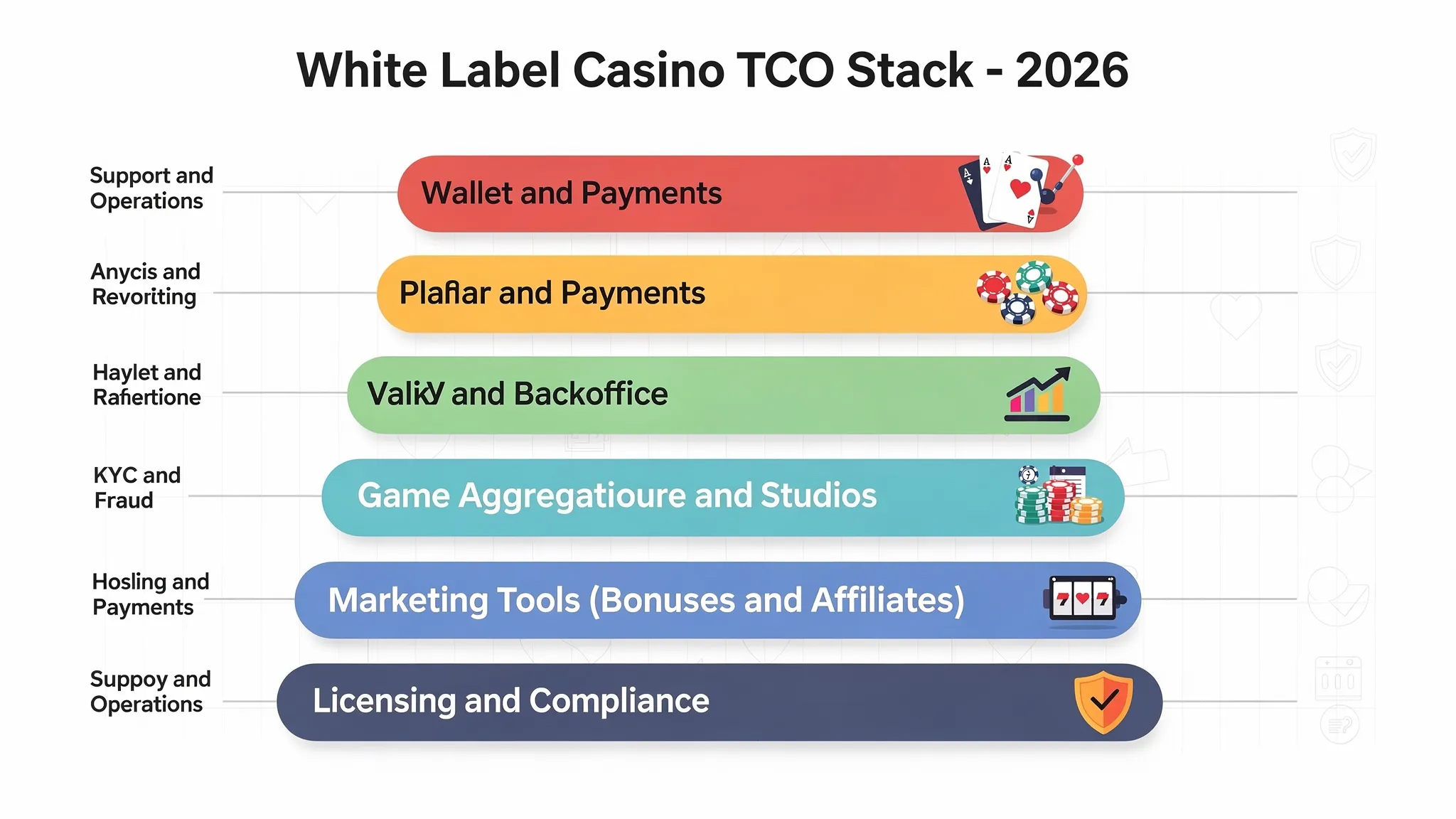
A useful way to budget is to treat your casino like a stack of cost layers. Vendors may bundle these, but the economics still exist.
1) Setup and onboarding fees (time-to-launch has a price)
Even “turnkey casino solution” offers often include one-time costs tied to:
- Brand setup (domain, theming, content, lobby configuration)
- Initial integrations (PSPs, crypto onramp, KYC vendor, affiliate trackers)
- Compliance configuration (jurisdiction rules, limits, reporting, responsible gambling tooling)
- Game certification and enablement steps (jurisdiction-dependent)
Common pricing traps
If a vendor advertises “fast onboarding,” confirm whether fast means:
- You get a templated configuration, or
- You get engineering time included, or
- You get a project plan but pay for the work.
2) Game aggregation and content costs
Game content is frequently the largest long-term cost line item, and it is where contracts get messy.
You may pay through:
- An aggregator rev share
- Provider-by-provider commercial terms
- “Premium game” surcharges
- Jurisdictional certification and reporting pass-throughs
If you want a deeper breakdown, Spinlab’s guide on the true cost of a game aggregator is a good reference point for what tends to appear after you sign.
2026 reality: content strategy is not just “how many games.” It’s latency, uptime, reporting, and whether you can add or remove studios without renegotiating your platform contract.
3) Payments: processing fees, chargebacks, and cashier add-ons
Payments cost is not only “PSP fees.” It includes operational and fraud cost.
Typical cost components include:
- Deposit processing (cards, bank rails, alternative payment methods)
- Withdrawals and payout rails
- Chargebacks and dispute ops (tools plus staff time)
- Crypto flows (onramp fees, network fees, custody, travel rule coverage where relevant)
If you need a more operational view, see Spinlab’s work on crypto vs fiat payment gateways and LTV and its compliance angle in Travel Rule compliance for crypto casinos.
4) KYC, AML, and compliance operations
Many first-time operators budget for a KYC vendor and forget the rest:
- Manual review workload (false positives, resubmissions, escalations)
- Ongoing monitoring (risk scoring, sanctions screening, transaction monitoring)
- Evidence retention and audit readiness
If your platform includes KYC/AML tooling, clarify whether the cost is:
- Included as a module
- Billed per verification
- Billed per active player, per month
Also note that PCI DSS scope choices can change both cost and architecture decisions for payment data. (PCI DSS is maintained by the PCI Security Standards Council, see official standards resources.)
5) Hosting, performance, and scale costs
Infrastructure costs scale with concurrency, real-time analytics, streaming, and traffic spikes. Your vendor may include hosting, or you may bring your own.
Either way, price it explicitly:
- Base compute and database cost for steady-state traffic
- Burst capacity (marketing pushes, jackpots, big streamers)
- Observability (logs, traces, retention)
- Backups, disaster recovery, and region expansions
A practical budgeting lens is CapEx vs OpEx: what is fixed versus what grows with usage. If you want a framework, see Budgeting for a Casino Startup: CapEx vs OpEx Explained.
6) Backoffice, analytics, and “included” tools that become paid later
In 2026, many operators expect these to be included:
- Real-time analytics dashboards
- Bonus engine and segmentation
- Affiliate tracking and commission tooling
- Multi-currency wallet views and reconciliation
But contracts often limit one of the following:
- Number of admin seats
- Event volume, API calls, or reporting exports
- Number of brands (skins) or markets
If analytics matters to your growth plan, confirm whether “real-time” is truly included or an enterprise add-on. (Spinlab’s perspective on high-leverage metrics is in Real-Time Analytics in iGaming.)
7) Support, SLA tiers, and incident costs
Support is one of the most common hidden costs because it is rarely compared fairly.
Ask specifically:
- Is support 24/7 for payments and gameplay incidents, or business-hours only?
- Are incident response and postmortems included?
- Do you get a named account manager, or a ticket queue?
- Is there a separate fee for “priority” or “regulatory” support?
The hidden extras checklist (the stuff that changes your year-1 total)
Most budget surprises come from a small set of categories.
| Hidden cost category | How it appears in contracts | Why it matters |
|---|---|---|
| Additional brands/skins | “Per brand” monthly fees | Multi-brand growth becomes expensive fast |
| Customization and theming | “Custom work” hourly or per sprint | You lose the speed advantage of white label |
| Integrations and APIs | Setup fee, middleware fee, or “API overage” | You pay more as you automate more |
| Compliance changes | “Regulatory updates” billed as change requests | Every market expansion becomes a mini project |
| Reporting exports and data access | Paid data warehouse, paid raw events | You can’t measure LTV and fraud properly |
| Fraud tooling | Charged per rule pack or per volume | Fraud costs rise as you scale |
| Player communications | SMS and email fees, push infrastructure | Lifecycle marketing becomes a metered cost |
How to model “what you really pay” (a simple 24-month TCO approach)
You do not need a perfect spreadsheet, you need a defensible one.
Step 1: Separate fixed, variable, and pass-through costs
- Fixed: platform base fee, hosting base, support tier
- Variable: revenue share, payment processing, KYC checks, fraud tooling, messaging
- Pass-through: game studio costs, certification fees, third-party vendor fees
Step 2: Forecast with ranges, not single numbers
Build three scenarios:
- Conservative (slow acquisition, low VIP share)
- Base case
- Upside (fast growth, higher withdrawals, higher support load)
Then test sensitivity on the few multipliers that usually dominate the total:
- Payment mix (cards vs bank rails vs crypto)
- Chargeback rate and dispute volume
- Game portfolio mix (premium studios vs long-tail)
- KYC pass rate and resubmission rate
Step 3: Force every vendor quote into the same unit
Vendors quote pricing in incompatible units on purpose. Normalize to a small set:
- Cost per active player per month
- Cost per deposited player
- Percentage of NGR
- Cost per transaction
When you can express each line item in one of those units, comparison becomes much easier.
Negotiation questions that protect you in 2026
Pricing is only half the negotiation. The other half is making sure your “future state” is not punished.
Define revenue precisely
If you are offered rev share, the definition matters more than the percentage.
Clarify:
- Is it based on GGR or NGR?
- What deductions are allowed (bonuses, payment fees, chargebacks, affiliate commissions)?
- Are there caps, floors, or step-down tiers as volume grows?
Ask for module clarity in writing
If the platform is “all-in-one,” confirm what that means contractually:
- What payment methods are included versus paid connectors?
- Is crypto onramp included or an additional vendor relationship?
- Are KYC/AML features included, and what is per-check pricing?
Protect multi-brand expansion
If your plan includes multiple skins, negotiate the economics early:
- A flat fee for additional brands
- A discounted per-brand tier after brand #2
- A cap on total per-brand fees
Confirm data access and portability
A cheap platform becomes expensive if you cannot export data cleanly.
Make sure you have clear rights to:
- Raw event streams (or equivalent exports)
- Finance-grade reporting
- Player history, limits, and audit logs
When the “cheapest white label casino” is not actually cheapest
A low sticker price often assumes you will:
- Use the vendor’s preferred payment stack
- Accept limited customization
- Run a single brand in a single market
- Avoid unusual compliance or reporting needs
If any of those are untrue, the cheapest option can become the most expensive through change requests, add-ons, and slow iteration.
A more reliable way to choose is to combine price with time-to-value:
- How fast can you ship a new payment method?
- How fast can you launch a new market?
- How quickly can you respond to fraud patterns?
Those are operational costs that show up as revenue leakage if your stack is slow.
Where Spinlab fits (without the pricing fog)
Spinlab Studio positions itself as an all-in-one, modular iGaming platform for building and scaling online casinos, with crypto and fiat payments, game aggregation, KYC/AML compliance, fraud prevention, real-time analytics, and an admin backoffice.
If you are specifically trying to avoid “add-on pricing creep,” a good next step is to request a quote that breaks costs into the same categories used in this article (platform, games, payments, compliance, hosting, support), so you can compare apples to apples.
Frequently Asked Questions
How much does a white label casino cost in 2026? It depends on your business model (fixed fee vs revenue share), game portfolio, payment mix, and compliance scope. The most accurate way to estimate is to model 24-month TCO across platform fees, games, payments, KYC/AML, hosting, and support, then run conservative and upside scenarios.
What are the biggest hidden costs in white label casino pricing? The most common surprises are game aggregation extras, payment-related costs (including chargebacks and disputes), per-check KYC fees, paid API access or overages, additional brand fees, and customization work billed outside the base plan.
Is revenue share or fixed monthly pricing better? Revenue share can reduce upfront costs but becomes expensive as you scale, and it can be hard to compare across vendors due to different revenue definitions. Fixed pricing is easier to budget, but only if the contract clearly includes core modules (payments, KYC/AML, analytics) without constant add-ons.
Do white label platforms include licensing and compliance? Some platforms include compliance tooling (KYC/AML workflows, limits, audit logs), but licensing itself is typically a separate legal process and cost. Always confirm what the vendor provides (tooling, integrations, templates) versus what you must source independently.
How do I compare two casino software providers fairly? Normalize every quote into a small set of units (cost per active player, per deposited player, per transaction, or percentage of NGR) and build a 24-month model that includes games, payments, compliance, hosting, and support. A low platform fee is not meaningful if games and payments are priced aggressively.
Get a transparent 2026 pricing breakdown
If you’re evaluating a white label casino platform and want a clear view of total cost, ask Spinlab for a breakdown that separates platform, games, payments, compliance, and support so you can model your true 24-month TCO.
Explore the platform at spinlab.studio or start with related decision guides like White Label vs Custom Casino: How to Choose and the true cost of a game aggregator.