

Casino tournament software turns ordinary play into scheduled, measurable competition. For an online casino operator, that means more than adding a leaderboard beside slot games or live casino games. The right tournament layer has to track game events in real time, enforce fair rules, automate rewards, protect against abuse and give your team enough control to launch campaigns without waiting on developers.
Tournaments are valuable because they sit between product, CRM and retention. A good tournament can reactivate quiet players, give VIPs a reason to return, support a new game launch or create a high-energy weekend event around a specific provider. A weak tournament setup does the opposite: delayed leaderboards, unclear scoring, manual prize handling and support tickets from players who do not trust the results.
Why tournaments matter for online casino operators
Casino tournaments work because they give players a goal beyond the next spin or hand. Instead of only playing against the game outcome, players compete for position, status and time-limited rewards. That format can increase session depth when it is designed responsibly and kept transparent.
For operators, tournaments also create useful campaign structure. Rather than giving the same free spins or bonus cash to everyone, teams can build events around segments, games, regions, currencies or player value bands. A new pragmatic slots release might get a short leaderboard race. A VIP group might get a private live casino challenge. A crypto-first audience might respond better to a weekend prize pool paid through a multi-currency wallet.
The software has to make these ideas operational. If your team needs engineering support for every rule change, prize update or eligibility tweak, tournaments become expensive to run. The best casino tournament software gives commercial teams freedom while keeping compliance, risk and finance controls intact.
The main tournament formats your platform should support
Operators do not need every format on day one, but they do need flexibility. Tournament mechanics should match the player segment, game category and campaign objective. A casual retention event needs different rules from a high-stakes VIP race.
If you are weighing a volume-based leaderboard against a classic tournament, our explainer on what a wager race is compares the two formats.
| Tournament format | Best use case | Key software requirement |
|---|---|---|
| Leaderboard race | Retention, weekend campaigns, provider launches | Real-time ranking and transparent scoring |
| Prize pool tournament | High-value events and VIP play | Automated allocation, tie rules and approval workflows |
| Mission or challenge | Onboarding and cross-sell between games | Event tracking across game categories |
| Sit-and-go tournament | Short sessions and instant engagement | Fast registration, start triggers and settlement |
| Network tournament | Multiple brands or markets | Scalable infrastructure and brand-level permissions |
Slot tournaments are usually the simplest starting point because spins, stakes and wins are easy to count. Live casino games add complexity because round timing, table availability and provider data can vary. If you run casino original games, the tournament layer should also support custom event definitions so you can score actions that are unique to your own content.
Casino tournament software feature checklist
A tournament module should not be treated as a cosmetic add-on. It touches the wallet, bonus engine, game aggregator, compliance stack, CRM and analytics layer. These are the features operators should evaluate before committing to a turnkey casino solution or extending an existing iGaming platform.
Real-time leaderboard accuracy
Leaderboards are the public face of a tournament. Players will judge the entire event by whether rankings update quickly and accurately. Delays of even a few minutes can create confusion, especially near the end of a prize race.
A strong leaderboard engine should support live ranking, configurable refresh rates, player aliases, tie-break logic and clear status labels. It should also handle high traffic near campaign deadlines, when players are most likely to refresh results repeatedly.
Accuracy depends on clean event ingestion from the game aggregator and wallet. If bets, wins or qualifying actions arrive out of order, the system needs reconciliation logic rather than simply displaying bad data. Operators should ask how the platform handles failed events, duplicate events and provider latency.
Flexible scoring rules
The scoring model determines player behavior. If you only rank by wager amount, the tournament may favor high-volume players and create riskier engagement. If you rank by net win, the event may feel more exciting but less predictable. If you score by number of qualifying spins, the tournament becomes more accessible to casual users.
Common scoring options include total wagered, highest single win, multiplier achieved, number of rounds played, net profit, mission completion and points per qualifying action. The software should let operators combine conditions, exclude certain games, set minimum stakes and apply different scoring weights.
Good scoring controls help commercial teams build campaigns that feel fair. They also help risk teams prevent obvious loopholes, such as players farming points on extremely low-volatility games or using minimal stakes to climb a participation leaderboard.
Prize automation and bonus engine integration
Prizes can include cash, bonus funds, free spins, physical rewards, VIP perks, crypto payouts or entries into another event. The operational risk is not the reward itself, but the manual work around it. If prizes are exported to a spreadsheet and uploaded later, mistakes become likely.
Casino tournament software should connect to the bonus engine so prizes can be issued automatically based on final ranking, eligibility and approval rules. For complex promotions, it should support staged settlement, manual review for flagged winners and clear audit logs showing who received what.
This is where bonus logic matters. Wagering requirements, expiry dates, max cashout rules and country restrictions should apply consistently. If you are defining your broader promo stack, Spinlab's guide to casino bonus engine requirements covers the controls operators should expect before scaling campaigns.
Eligibility, segmentation and opt-in controls
Not every player should be eligible for every tournament. Operators may need to segment by jurisdiction, currency, VIP tier, acquisition source, account status, KYC level, risk score or responsible gambling limits.
An effective tournament module should support opt-in and automatic enrollment. Opt-in works well for marketing consent and player clarity. Automatic enrollment can reduce friction for low-risk campaigns, but the rules still need to be visible and enforceable.
Segmentation should be dynamic. If a player becomes restricted, self-excludes or fails a verification requirement, the tournament system needs to react quickly. That may mean removing the player from the leaderboard, pausing prize eligibility or moving the case into a manual review queue.
Game aggregation compatibility
Tournaments only work well if the platform can consume accurate game data. For operators using multiple providers, a seamless game aggregator is critical. It should normalize events across slot games, live casino games and any custom titles the operator offers.
Provider coverage is not enough on its own. Operators should ask whether the tournament layer can filter by studio, game, volatility category, launch date or custom game group. This matters for campaigns around new hacksaw slots, new pragmatic slots or other provider-specific launches where marketing wants to promote a limited catalog.
The best setup lets non-technical teams create game groups from the backoffice, attach those groups to tournaments and preview how qualifying activity will be counted before the campaign goes live.
Wallet and multi-currency support
Tournament activity is tightly connected to wallet behavior. Players need to know which bets qualify, which balance was used, how prizes are paid and whether conversion rules apply.
For international and crypto-ready operators, multi-currency support is especially important. A tournament may accept players using fiat, stablecoins or other supported crypto balances. The software must define whether scoring is based on native currency, converted value or a points system that avoids currency distortion.
Prize settlement should be just as clear. If a player qualifies in one currency and receives a reward in another, the exchange logic and timestamp should be auditable. Operators using a crypto onramp or custodial wallet setup should also verify how deposits, withdrawals and bonus balances interact with tournament eligibility.
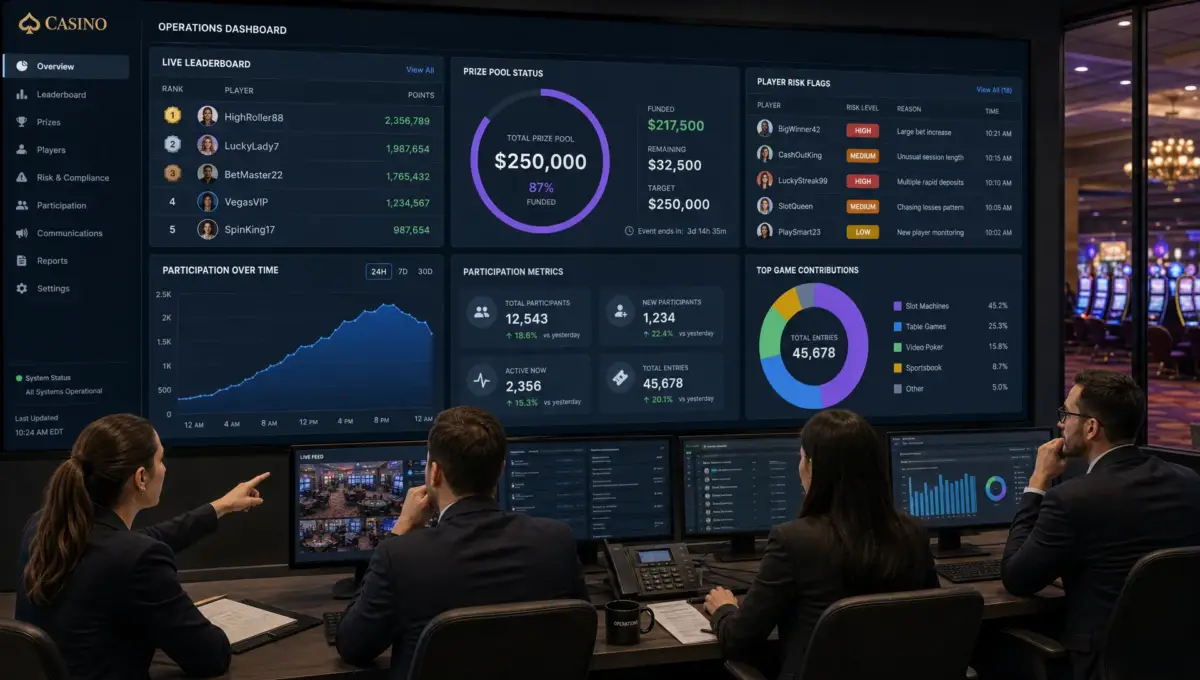
Fraud prevention and fair play controls
Competitive campaigns attract abuse. Tournament fraud can include multi-accounting, collusion, bonus abuse, bot-assisted play, chip dumping in applicable games, payment fraud and attempts to exploit scoring rules.
A tournament system should work with the wider fraud stack rather than operate in isolation. Useful controls include duplicate account detection, device intelligence, IP and geolocation checks, velocity rules, suspicious betting pattern alerts, manual winner review and configurable prize holds.
Operators also need rules that prevent promo abuse without punishing normal play. For example, a platform might flag sudden activity from newly created accounts, repeated behavior across linked profiles or qualifying play funded by disputed deposits. For a deeper view of the risk layer, Spinlab's article on casino fraud prevention tools explains the controls that support safer operations beyond tournaments.
Fairness also has a communication side. Players should see clear terms, qualifying games, minimum stakes, start and end times, prize rules and tie-breakers. A transparent tournament is easier to defend when a player disputes the outcome.
Backoffice tools operators need
Tournament software should reduce operational work, not create another admin burden. The backoffice experience matters because campaign managers, risk analysts, support agents and finance teams all need different views of the same event.
The campaign builder should let teams create, duplicate, schedule, pause and end tournaments without code. It should include draft previews, permission levels, approval flows and version history. If a rule changes before launch, the system should show exactly what changed and who approved it.
Support teams need fast lookup tools. When a player asks why they are not on a leaderboard, agents should be able to see opt-in status, qualifying play, excluded games, risk flags and reward history from one view. This reduces escalations and avoids inconsistent answers.
Finance and compliance teams need exportable reports, settlement logs and prize liability visibility. If a tournament has a guaranteed prize pool, the platform should help track exposure before the event ends.
Operators evaluating admin workflows can also compare tournament needs with broader backoffice tools for online casino operators, since the same principles apply: fewer disconnected screens, clearer permissions and better auditability.
Compliance, responsible gambling and auditability
Tournament campaigns are marketing tools, but they still sit inside a regulated gambling environment. The exact requirements depend on licensing jurisdiction, so operators should always confirm rules with legal and compliance teams.
At a software level, the tournament module should support age and identity verification dependencies, geolocation restrictions, bonus term enforcement, self-exclusion checks, responsible gambling limits and full audit logs. If a player is blocked from promotional activity, the tournament engine must respect that status automatically.
Auditability is not optional. Operators need records of tournament configuration, leaderboard changes, prize settlement, manual overrides, player eligibility checks and communication history. Independent testing labs and regulators often focus on whether interactive gaming systems can produce reliable records. Gaming Laboratories International publishes GLI standards that many operators and suppliers use as a reference point for system integrity.
Responsible gambling controls should shape tournament design too. Avoid mechanics that pressure players into chasing unrealistic positions late in an event. Clear time limits, spend visibility, eligibility rules and opt-out options help keep tournaments sustainable.
Analytics that make tournaments better over time
Running a tournament is only half the job. Operators need analytics to understand whether the event improved retention, engagement and revenue quality without creating avoidable risk.
Useful metrics include registrations, opt-in rate, active participants, qualifying bets, average session length, bonus cost, prize liability, uplift versus control groups, reactivation rate, game mix, suspicious account rate and post-event retention. The dashboard should separate vanity numbers from operational insight.
For example, a tournament with high participation but low second-week retention may have attracted bonus hunters rather than loyal players. A VIP tournament with fewer participants may still be successful if it protects margin and increases repeat sessions among valuable players.
Analytics should also feed future segmentation. If certain markets prefer short missions while others respond to prize pool races, the operator can adjust campaign calendars instead of repeating the same format everywhere.
Build versus buy: what to evaluate before launch
Some operators consider building tournament software in-house. That can make sense for large teams with custom product requirements, but it is easy to underestimate the number of systems involved. The tournament layer must connect to games, wallet, bonus logic, payments, KYC, AML, fraud prevention, CRM, support tools and reporting.
Buying or using a white label casino platform can shorten time to market if the provider already has the necessary modules. The key is to evaluate depth, not just whether tournaments appear on a feature list.
Before choosing a casino software provider, ask practical questions:
- Can non-technical users create and schedule tournaments from the backoffice?
- Which game providers, game types and custom events can be scored?
- How are leaderboards reconciled when provider events arrive late?
- Can prizes be reviewed before settlement for flagged players?
- Does the system support fiat, crypto and multi-currency tournament rules?
- What audit logs are available for disputes, regulators and finance teams?
- Can the platform scale during peak traffic near tournament deadlines?
The best answer is rarely a single feature. It is the way the whole platform works together. Tournament mechanics are much easier to operate when they sit inside a modular iGaming platform with integrated payments, game aggregation, compliance tooling, analytics, fraud prevention and a usable backoffice.
How Spinlab supports tournament-ready casino operations
Spinlab is built for operators that want to launch and scale an online gambling platform without stitching together every core system from scratch. Its modular setup includes crypto and fiat payment support, game aggregation, KYC and AML compliance, fraud prevention, real-time analytics, multi-currency support, affiliate and bonus tools, open API integration and a customizable backoffice admin panel.
For tournament planning, that matters because the campaign itself depends on the surrounding infrastructure. A leaderboard needs accurate game events. A prize needs wallet and bonus logic. A winner review needs fraud and compliance context. A campaign manager needs a backoffice that feels simple enough to use without constant developer help.
Operators exploring whitelabel casino software should look for this connected approach, especially if they want fast onboarding, crypto-ready payments, mobile-optimized player journeys and room to add custom casino original games over time.
Frequently Asked Questions
What is casino tournament software? Casino tournament software is a platform module that lets operators create competitive events, track qualifying play, display leaderboards, enforce rules and settle prizes automatically or through controlled review workflows.
Which games work best for casino tournaments? Slot games are often the easiest starting point because spins, wagers and wins are straightforward to track. Live casino games, table games and casino original games can also work if the platform receives reliable event data and supports suitable scoring rules.
Should tournaments use cash prizes or bonus rewards? Both can work. Cash prizes are simple for players to understand, while bonus rewards can support retention when wagering rules and expiry terms are clear. Operators should choose rewards based on campaign goals, margin and compliance requirements.
How do operators prevent tournament abuse? Operators prevent abuse by combining eligibility rules, KYC checks, device intelligence, duplicate account detection, betting pattern monitoring, prize holds and manual review for flagged winners.
Can crypto casinos run tournaments? Yes, but the platform needs clear multi-currency rules, wallet integration, exchange rate logic, crypto onramp support where applicable and auditable prize settlement.
Launch tournaments with the right platform foundation
Tournaments can be a powerful retention and engagement tool, but only when the software behind them is accurate, flexible and connected to the rest of the casino stack. Leaderboards, scoring, prizes, fraud controls, compliance workflows and analytics all need to work together.
If you are building a whitelabel casino or upgrading your current platform, Spinlab offers a modular, crypto-ready casino platform designed for fast launch and scalable operations. Explore Spinlab Studio to see how an all-in-one platform can support payments, game aggregation, compliance, analytics and promotional workflows from one connected foundation.
