

Launching a casino brand without organic search is expensive from day one. Paid acquisition can validate markets quickly, but it also exposes new operators to rising CPA, strict ad rules and thin margins. A strong Casino SEO strategy gives your online casino a compounding acquisition channel, one that can bring qualified players through search intent, game discovery, bonus research and trust-building content.
For new operators, SEO is not just about blog posts. It touches your licensing pages, casino CMS structure, game catalog, payments content, bonus rules, internal linking, technical performance and affiliate relationships. The earlier you design it into the platform, the less cleanup you face after launch.
Why SEO Is Different for New Casino Operators
Casino SEO is more competitive than most verticals because the same commercial keywords attract operators, affiliates, review sites, media brands and software vendors. A new domain rarely wins by publishing generic articles such as best slots or how to play roulette without a clearer angle, stronger trust signals or a smarter page architecture.
Search engines also treat gambling content cautiously. Your pages need to help users make informed decisions while avoiding misleading claims about winnings, bonuses or risk. Google Search Central’s Search Essentials are a useful baseline: make content crawlable, avoid deceptive tactics and build pages for users rather than search engines alone.
Operators also face a practical constraint: many high-value pages are tied to compliance. Bonus terms, payment availability, KYC requirements, responsible gambling messaging and country restrictions can change by market. If your SEO team works separately from compliance and product, pages become outdated fast.
The goal is not to rank for every casino keyword. The goal is to rank for the searches that match your license, product strengths, supported currencies, game portfolio and player acquisition model.
Build the Casino SEO Strategy Foundation Before Launch
A new operator should define its search positioning before the first page template is built. The foundation of a Casino SEO strategy is a simple answer to three questions: who can legally play, why would they choose your brand and which pages prove that claim better than competitors?
Start by documenting your target markets, language versions, payment options, restricted territories and core product categories. This prevents wasted content production. For example, ranking for crypto casino terms is only useful if your platform supports the relevant payment flows, wallet experience and compliance checks.
Your technical setup also matters before launch. Choose URL structures, canonical rules, hreflang logic and indexation rules early. Casino sites can create thousands of low-value URLs through filters, providers, game tags and pagination. Without rules, Google may crawl duplicate pages while ignoring your important commercial pages.
| Launch decision | SEO impact | What to define early |
|---|---|---|
| Target markets | Determines keyword language, compliance copy and payment pages | Countries, languages, restricted locations |
| Game catalog | Shapes slot, live casino and provider landing pages | Providers, game types, release workflow |
| Bonus model | Influences bonus pages, terms pages and promotional content | Wagering rules, eligibility, abuse controls |
| Payment stack | Creates search demand around deposits and withdrawals | Fiat, crypto, onramps, processing limits |
| CMS structure | Controls crawl efficiency and editorial speed | Templates, metadata, internal links, schema |
Map Keywords to Player Intent, Not Just Volume
A useful Casino SEO strategy groups keywords by intent rather than chasing the largest search volumes. New operators often overinvest in broad head terms, then discover that those results are dominated by established domains and affiliate comparison sites.
Build around intent layers instead. Some players search for education, such as how wagering requirements work. Others compare brands, payment methods or game providers. The highest-value searches often come from people who already know what they want, such as fast withdrawal crypto casino, live blackjack online or Pragmatic Play slots casino.
| Search intent | Example query pattern | Best page type | Business role |
|---|---|---|---|
| Trust research | Is this casino licensed? | About, license, security, responsible gaming | Reduce doubt before registration |
| Payment intent | Deposit with USDT casino | Payment method landing page | Match payment preference |
| Game discovery | New Hacksaw slots online | Provider or release page | Capture game-led demand |
| Bonus evaluation | No deposit bonus terms | Bonus page with clear rules | Convert without misleading users |
| Support intent | How long do withdrawals take? | Help center or FAQ page | Lower support load and churn |
This mapping also helps you prioritize. If your online casino is strongest in crypto payments, mobile play and new slot releases, those should appear in your search architecture before broad editorial topics.
Design a Site Architecture That Can Scale
Your site architecture is where SEO strategy becomes operational. A casino launch typically needs a small set of high-quality commercial pages first, then scalable templates for games, providers, bonuses, payments and help content.
A smart Casino SEO strategy avoids two extremes. One extreme is a thin site with only a homepage, bonus page and registration flow. The other is an overbuilt site that indexes every filter combination, provider tag and game variation. Both make ranking harder.
For most new brands, the core structure should include:
- Homepage with clear brand positioning, licensing context and primary product categories.
- Casino category pages for slots, live casino games, table games, original games and jackpot games.
- Provider pages for important studios, such as Pragmatic Play, Hacksaw Gaming and Evolution where relevant.
- Payment pages for supported fiat methods, crypto deposits, withdrawals and crypto onramp options.
- Bonus pages with transparent terms, eligibility rules and responsible gambling copy.
- Help and trust pages covering KYC, AML, security, complaints and account safety.
For deeper execution on category templates, taxonomy and avoiding index bloat, Spinlab’s guide to casino CMS category pages that rank and convert is a useful next step.
Create a 90-Day Content Plan for Launch
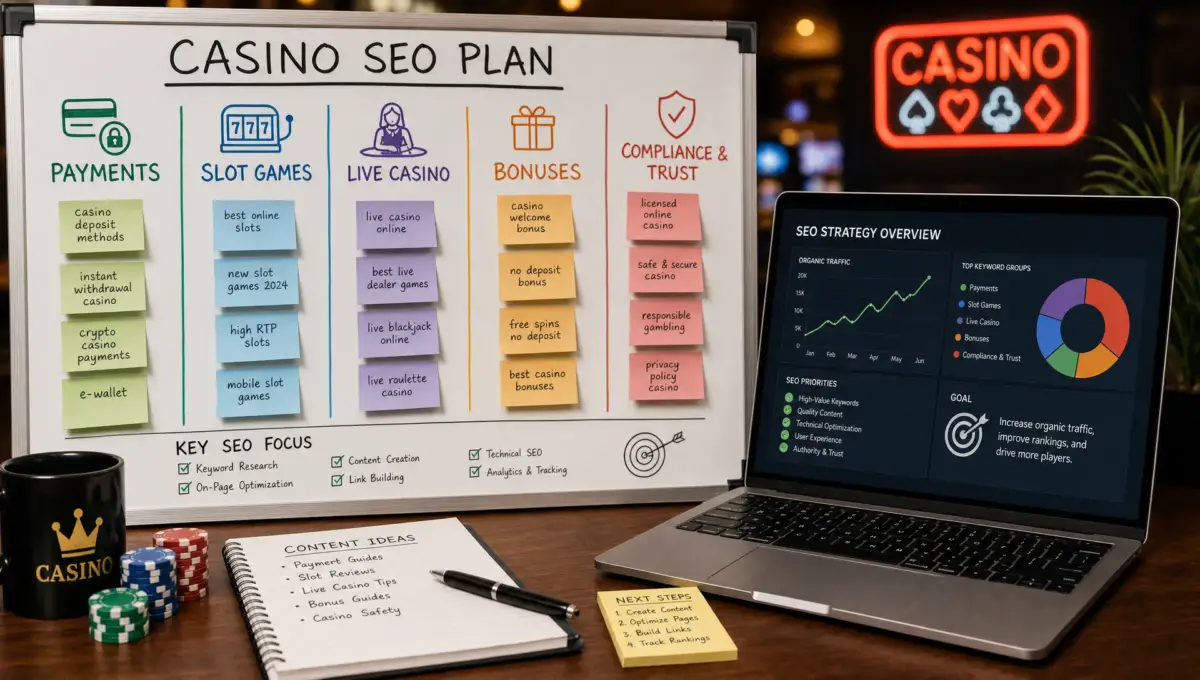
New operators should treat the first 90 days as a controlled buildout, not a publishing sprint. A Casino SEO strategy works better when each content asset has a job: support conversion, capture demand, earn links or reduce friction.
In month one, publish the essential trust and product pages. These include licensing information, payment methods, responsible gambling, bonus terms, KYC explanation, privacy and game category pages. This content may not bring large traffic immediately, but it supports every acquisition channel.
In month two, expand into game-led and provider-led content. If your catalog includes slot games, build pages around meaningful player discovery patterns: volatility, themes, bonus features, new releases and provider collections. For live casino games, focus on tables, game shows, mobile experience and dealer formats.
In month three, start recurring content workflows. Slot release coverage is one of the most practical examples because new Pragmatic slots and new Hacksaw slots create time-sensitive searches. A structured calendar helps your team prepare pages before demand peaks instead of reacting after competitors have already published. Spinlab’s article on planning slot release calendars for SEO covers that workflow in more detail.
Prioritize Technical SEO From the Platform Layer
Technical SEO is not a polish task for the week before launch. For an online gambling platform, technical decisions affect crawling, compliance updates, speed, mobile usability and analytics accuracy. A Casino SEO strategy should be built into the iGaming platform stack from the beginning.
Start with crawl control. Game catalogs can be large, especially when a game aggregator feeds hundreds or thousands of titles into the lobby. Not every game URL deserves to be indexed. Your CMS should let you decide which pages are indexable, which are canonicalized and which are useful only inside the player experience.
Performance is equally important. Casino users often browse on mobile, switch between lobby pages and expect fast loading across game thumbnails, promotions and payment flows. Compress images, avoid unnecessary scripts and keep core templates clean. If a page is too slow to use, rankings and conversion both suffer.
Structured data can clarify your pages, but it cannot compensate for thin content. Follow Google’s structured data guidelines, use accurate markup and avoid adding schema that does not match visible content. For casino-specific JSON-LD patterns, a dedicated implementation guide is usually safer than copying generic templates.
Build Trust Signals Into Every Important Page
Search performance in gambling is tied to trust. Players want to know whether they can deposit safely, withdraw reliably and understand the rules before they create an account. Google also rewards pages that demonstrate experience, transparency and accountability.
A strong Casino SEO strategy adds trust signals where decisions happen, not only in the footer. Payment pages should explain supported currencies, fees if applicable, withdrawal steps and verification requirements. Bonus pages should make wagering, limits and eligibility easy to understand. Game pages should avoid implying guaranteed returns or outcomes.
Responsible gambling content should be visible and practical. This includes age restrictions, self-exclusion information, deposit limits, support resources and market-specific requirements. Compliance is not just a legal layer, it is part of the user experience.
New operators should also connect SEO planning with operational controls. KYC, AML, fraud prevention and responsible gaming workflows affect what you can truthfully say on your site. For a broader operational view, Spinlab’s casino compliance stack for new operators explains the core components that should be in place from launch.
Use Authority Building Without Risky Shortcuts
Link building in casino SEO is difficult because many sites either avoid gambling content or charge premium rates for placements. That pressure leads some operators toward low-quality networks, expired domains and paid links that leave obvious footprints.
A sustainable Casino SEO strategy uses authority building that matches the brand. Affiliates can be valuable, but the relationship should be commercial, compliant and trackable. Digital PR can work when you have real stories, such as game launches, original casino games, payment innovation or market expansion. Provider partnerships may also create legitimate opportunities for mentions and links.
Avoid tactics that exist only to manipulate rankings. Google’s spam policies specifically address link spam, scaled abuse and deceptive practices. In a regulated category, the downside of aggressive shortcuts is larger because reputational damage can affect affiliates, payment partners and licensing conversations.
Better authority building starts with assets worth referencing. Publish clear bonus terms, original data from your lobby or payment experience where legally appropriate, transparent game guides and useful responsible gambling resources. These assets support affiliates and players at the same time.
Measure SEO Like an Operator, Not a Publisher
Traffic alone is a weak success metric for casino SEO. A guide can bring thousands of visitors who never register, while a payment page with modest traffic may produce qualified depositors. A practical Casino SEO strategy connects rankings to business outcomes.
Track SEO performance across the player journey. Organic sessions matter, but so do registrations, first-time deposits, KYC completion, bonus activation, retention and revenue quality. If a keyword attracts players who claim bonuses and churn immediately, it may be less valuable than a lower-volume page that brings verified repeat depositors.
| Metric | Why it matters | Useful segmentation |
|---|---|---|
| Organic landing page sessions | Shows which pages attract search demand | Market, device, page type |
| Registration rate | Measures page-to-account conversion | Keyword cluster, bonus type |
| First-time depositor rate | Connects SEO to revenue | Payment method, country |
| KYC completion rate | Reveals compliance friction | Document type, market |
| Player value over time | Prevents overvaluing low-quality traffic | Game preference, acquisition page |
| Indexed pages vs valid pages | Finds crawl waste and duplicate content | Template, language, tag |
This measurement model also helps editorial teams. If provider pages convert better than generic guides, publish more provider content. If crypto onramp pages attract support questions, improve the copy before scaling acquisition.
Common SEO Mistakes New Casino Operators Make
The most common mistake is launching with a platform first and adding SEO later. By then, the CMS may lack flexible metadata, game pages may be duplicated and compliance pages may sit outside the conversion journey.
Another weak point is copying competitor content structure without understanding the business model behind it. Affiliate sites rank with comparison pages because they are built for comparison intent. Operators need content that also supports registration, deposits and long-term player trust.
A third mistake is publishing bonus pages that overpromise. If the title says best no wagering bonus but the terms include heavy restrictions, users lose trust and the page may attract the wrong kind of traffic. Bonus content should sell the offer clearly without hiding conditions.
New brands also underestimate internal linking. Your homepage, lobby, provider pages, bonus pages and payment pages should reinforce one another. Search engines and users both need clear paths from discovery to decision.
How Spinlab Supports SEO-Ready Casino Launches
Spinlab is built for operators who want to launch and scale an online casino without assembling every core system from scratch. Its modular iGaming platform supports crypto and fiat payments, game aggregation, KYC and AML compliance, fraud prevention, analytics, mobile optimization, affiliate and bonus tooling, customizable backoffice administration, open API integration, multi-currency support, crypto onramp solutions and merchant custodial wallets.
For SEO, the main advantage is operational alignment. When your game catalog, payments, compliance workflows, analytics and CMS experience are part of a connected platform, your marketing team can publish and optimize with fewer bottlenecks. That matters for new operators because speed, accuracy and consistency often decide whether organic search becomes an asset or another backlog item.
Spinlab also provides a Shopify-like experience for white label casino operations, which helps lean teams manage launch workflows without needing a large technical department from day one. Operators can focus their Casino SEO strategy on market positioning, content quality and conversion rather than rebuilding the basics.
Frequently Asked Questions
How long does casino SEO take for a new operator? New domains usually need several months to build crawl history, content depth and authority. Early pages can still support conversion immediately, especially trust, payment, bonus and game category pages.
Should a new casino focus on blog content or commercial pages first? Commercial and trust pages should come first. Blog content is useful, but it performs better when the site already has strong category, provider, payment and bonus pages to link to.
Can a white label casino platform rank in Google? Yes, but only if the operator controls enough unique content, technical settings, page structure and brand positioning. Duplicate templates and thin game pages can limit performance.
Is crypto casino SEO different from regular casino SEO? The core principles are similar, but crypto-focused pages need clearer explanations around supported coins, onramps, withdrawals, custody, verification and market restrictions.
Do casino sites need schema markup? Schema can help search engines understand page entities and content types, but it should match visible content and follow Google’s policies. It is not a shortcut for rankings.
Build Your Casino SEO on the Right Platform
Organic growth is easier when your platform, CMS, payments, compliance and game catalog are built to work together. If you are planning a new online casino or evaluating whitelabel iGaming software, Spinlab gives operators a flexible foundation for launching faster, supporting crypto-ready payments and scaling with a modular casino platform.
A strong SEO plan will not replace licensing, compliance or product quality. It will make each of those strengths easier for players to find, understand and trust.
