

Casino promotions can lift deposits, reactivate quiet accounts and introduce players to new games, but only if the offer is built around margin from the start. Too many online casino teams treat bonuses as a traffic expense, then discover later that the players acquired through the campaign are low-value, high-risk or impossible to retain without more discounts.
Profitable promotion design is not about being stingy. It is about matching the right incentive to the right player behavior, pricing the risk before launch and measuring whether the offer created incremental value. For casino operators, that means promotions need to be planned with finance, product, payments, fraud and compliance in the same room.
Why casino promotions become unprofitable
The simplest reason casino promotions lose money is that teams optimize for visible activity instead of net value. A campaign can look successful when deposits spike, free spins are claimed and email clicks rise, yet still destroy margin if too much of the play comes from bonus hunters, low-margin games or players who were already going to deposit.
The difference between volume and profit
A promotion should be judged by incremental net gaming revenue, not by total handle, total deposits or claims alone. Handle can rise because the bonus created more play, but it can also rise because players recycled bonus funds through low-volatility games with little real-money exposure.
Profit-focused teams ask a harder question: what changed because this promotion existed? If 1,000 players claimed a reload bonus but 700 of them would have deposited anyway, the offer may have subsidized existing behavior. That is not always bad for VIP retention or churn prevention, but it should be priced differently from true acquisition.
The hidden costs that get missed
Most promotion reports show bonus issued and revenue generated. That is not enough. A casino promotion has operational costs, risk costs and channel costs that can turn a positive-looking campaign negative.
| Cost item | Why it matters | Common mistake |
|---|---|---|
| Bonus value | Free spins, cash bonus, cashback or prize pool | Counting issued bonus but not expected liability |
| Game provider fees | Different slot games and live casino games carry different commercial terms | Promoting high-cost games without margin checks |
| Payment costs | Card, wallet, bank transfer and crypto rails have different fees | Treating all deposits as equal |
| Affiliate commission | CPA, hybrid and rev-share deals change campaign economics | Paying affiliates on players who only claim bonuses |
| Fraud and abuse | Multi-accounting, arbitrage and chargebacks can erase margin | Launching before risk rules are ready |
| Tax and regulatory costs | Varies by jurisdiction and product | Measuring gross revenue without required deductions |
If your iGaming platform does not make these costs visible at campaign level, your marketing team is flying blind. A promotion that looks profitable in the CRM may be underwater once payment gateway fees, provider fees and affiliate payouts are added.
How to model casino promotions before launch
A practical model does not need to be complex, but it must be consistent. Before approving casino promotions, build a one-page forecast that estimates expected revenue, costs, abuse exposure and the break-even point. This turns promotion planning from a creative debate into a commercial decision.
Start with a simple promotion P&L
Use net gaming revenue as the baseline whenever possible. Gross gaming revenue is useful, but it can hide important deductions. A clean starting formula is:
Expected profit = incremental NGR minus bonus cost minus channel cost minus payment cost minus risk cost minus operational cost
The word “incremental” is doing most of the work. If a campaign gives a 50 percent reload bonus to players who deposit every Friday without an incentive, the incremental value may be small. If it brings back a valuable player who has been inactive for 21 days, the same bonus may be profitable.
Define the break-even point
Every offer needs a break-even target before it goes live. For a deposit bonus, this might be the number of wagering cycles required to recover bonus cost. For free spins, it might be the expected conversion from free spin win to real-money deposit. For cashback, it might be the retained play generated after the player receives the rebate.
A useful pre-launch table looks like this:
| Promotion type | Main cost driver | Break-even question | Best-fit objective |
|---|---|---|---|
| Free spins | Spin value and game RTP | How many claimants make a real-money deposit? | Activation, game discovery |
| Reload bonus | Match percentage and max cap | What incremental deposits come from the offer? | Repeat deposit, payday campaign |
| Cashback | Loss rebate percentage | Does retained play after cashback cover the rebate? | Retention, VIP protection |
| Tournament | Prize pool and operations | Does competition lift sessions enough to cover prizes? | Engagement, mid-value retention |
| Mission or quest | Reward value and completion rate | Do missions move players into higher-value habits? | Habit building, cross-sell |
This table should be updated with actual results after each campaign. Over time, your casino builds a proprietary promotion library that shows which offers work by segment, market, game type and payment method.
Add caps before adding generosity
The fastest way to make a promotion safer is not always to lower the headline offer. It is often to add smarter caps. A “100 percent up to $50” bonus can be easier to control than a vague reward with no max liability. A free spins campaign with a win cap can still feel attractive while limiting outlier exposure.
Caps should cover more than the headline amount. Consider maximum bonus, maximum conversion amount, maximum bet while wagering, eligible games, expiry time, withdrawal requirements and player eligibility. These terms protect profitability, but they also improve player trust when written clearly.
Segment offers by player value, not just by channel
Many unprofitable casino promotions happen because everyone receives the same incentive. New players, casual players, VIPs, bonus-sensitive players and high-risk accounts do not have the same economics. A campaign that works for one group can lose money on another.
Build segments around behavior
Good segmentation starts with behavior, not demographics alone. A player’s deposit frequency, game preference, average bet size, bonus history, withdrawal patterns and recency often explain promotion profitability better than age or location.
For example, a player who deposits small amounts every week and plays high-volatility slots may respond well to a low-cost mission. A high-value live casino player may prefer cashback or event access over free spins. A bonus hunter who only deposits when a large match is available should be moved into lower-liability offers or excluded from certain campaigns.
Use risk signals in promotion eligibility
Eligibility rules should combine marketing value with risk controls. If a player has incomplete KYC, repeated failed deposits, chargeback indicators or suspicious multi-accounting patterns, they should not receive high-liability bonuses. This is especially important for operators that support both fiat and crypto, since payment behavior can differ across methods.
A crypto-ready solution can help operators serve global players, but promotions still need fraud prevention, AML workflows and responsible gaming controls. The objective is not to block legitimate crypto users. It is to avoid giving bonus value to accounts that have not proven they are trustworthy.
Avoid overpaying your loyal players
Loyal players deserve recognition, but not every loyal player needs a large bonus to keep playing. Many are more motivated by early access, status, challenges, personalized tournaments or small surprise rewards. Spinlab has covered several practical alternatives in its guide to low-cost retention campaigns that beat big bonuses, which is a useful reference when you want to protect margin without making retention feel flat.
The goal is to reserve expensive incentives for moments where they change behavior: preventing churn, moving a player to second deposit, recovering a failed payment or reactivating someone with proven historic value.
Choose the right mechanic for the job
Profitable casino promotions start with one clear objective. If the objective is first deposit conversion, the offer should reduce hesitation. If the objective is retention, the offer should build habit. If the objective is game discovery, the promotion should introduce a category without creating a permanent expectation of free play.
Acquisition promotions
Acquisition offers need strict payback discipline because the operator does not yet know the player’s true value. Welcome bonuses, no-deposit free spins and first deposit matches can work, but they should be tied to KYC completion, verified payment methods and sensible wagering rules.
Affiliate traffic needs extra care. If affiliates are paid CPA and the player receives a large welcome bonus, the operator may carry both the acquisition cost and the bonus liability before knowing whether the player will retain. That does not mean CPA is bad. It means the campaign should have deposit quality checks, minimum activity rules and fraud filters.
Activation and second deposit promotions
Second deposit campaigns are often more profitable than broad welcome campaigns because the player has already shown intent. A smaller incentive can be enough to move them from curiosity to habit. Free spins on a selected game, a small reload with a tight cap or a mission that rewards a second real-money session can outperform a larger generic match.
This is where game selection matters. If you are promoting new slot games, choose titles that fit your commercial model and player preferences. A game aggregator makes testing easier because operators can rotate content, compare engagement and avoid relying on one provider or category.
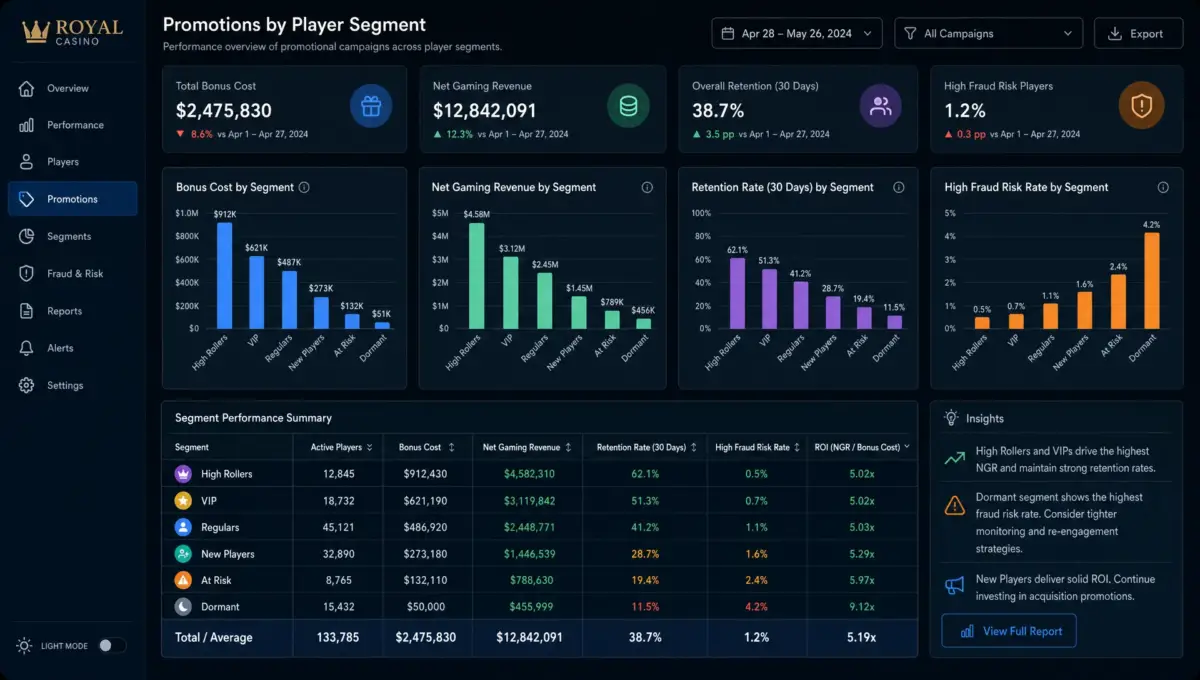
Retention and reactivation promotions
Retention promotions should be designed around timing. A good offer sent too early wastes money, while the same offer sent after signs of churn can save a valuable player. Lapsing players may respond to a mystery reward, a time-limited cashback offer or a mission that asks them to complete a short sequence of sessions.
Real-time data helps here because player intent changes quickly. A failed deposit, a sudden drop in session frequency or a shift from real-money play to browsing can all trigger a more relevant offer. Spinlab’s guide on using real-time data to improve casino retention goes deeper into how operators can turn live behavior into timely retention actions.
Write bonus rules that protect margin and player trust
Promotion terms are not just legal copy. They are commercial controls. The best rules reduce abuse without confusing legitimate players. If the terms feel deliberately obscure, players will complain, support costs will rise and regulators may take interest.
Make wagering requirements commercially realistic
Wagering requirements should reflect the expected value of the offer, the eligible games and the player segment. Very high wagering may protect the operator on paper, but it can also reduce trust and conversion. Very low wagering may attract arbitrage and bonus abuse.
A better approach is to combine moderate wagering with clear limits. Set game contribution percentages, maximum bet size while wagering, expiry windows and withdrawal rules. If live casino games contribute differently from slot games, say so plainly. If certain titles are excluded because of high RTP or provider restrictions, make that visible before the player opts in.
Use expiry windows carefully
Short expiry windows reduce liability, but they can also push players into rushed behavior. Longer expiry windows feel friendlier, but they keep liabilities open. The right window depends on the promotion type. A weekend reload bonus may need a short window, while a loyalty mission can run longer because it is designed to build habit.
Regulated markets also require care around fairness, advertising and responsible gambling. The UK Gambling Commission Licence Conditions and Codes of Practice is one example of how regulators frame operator responsibilities around marketing and consumer protection. Rules differ by jurisdiction, so legal review should be built into the campaign workflow.
Do not hide the catch
Players can accept limits when they understand them. They become frustrated when restrictions appear after they win. Clear terms reduce disputes and help support teams resolve issues faster. A profitable promotion that damages trust is not truly profitable, because the brand pays later through churn, complaints and lower lifetime value.
Measure incremental lift, not vanity metrics
The reporting phase is where profitable operators separate themselves from bonus-heavy competitors. They do not stop at claims and deposits. They measure whether the promotion created behavior that would not have happened otherwise.
Use holdout groups when possible
A holdout group is a small group of eligible players who do not receive the promotion. Comparing the promoted group against the holdout helps estimate incremental lift. Without a holdout, a campaign may get credit for natural payday activity, seasonal demand or a sports event that would have boosted deposits anyway.
Holdouts do not need to be complicated. For a retention campaign, you might withhold the offer from 5 to 10 percent of eligible players, then compare deposit rate, NGR, churn and support tickets. The key is to define the test before launch, not after the results arrive.
Track quality after the offer ends
Some promotions look profitable during the campaign but fail after the incentive disappears. That is common when players join only for bonus value. Track post-promotion behavior for at least one or two player cycles, depending on your market and product.
Useful post-campaign metrics include retained deposit rate, NGR per active player, withdrawal rate, bonus-to-deposit ratio, repeat session rate, complaints, fraud flags and exclusion activity. If a campaign creates more support problems or responsible gaming interventions, that cost belongs in the analysis.
For operators building a more mature measurement system, the Spinlab article on a casino analytics stack from events to profit actions explains how gameplay, payments, identity and marketing data can be connected into decisions that improve margin.
Build a promotion operating system
A one-off profitable campaign is useful. A repeatable promotion system is much more valuable. Operators should create a workflow that controls ideation, approval, launch, monitoring and post-campaign learning.
What the workflow should include
A strong promotion workflow gives marketing speed without removing financial discipline. Teams should be able to launch quickly, but not without the controls that protect the business.
- Objective: The behavior the promotion is designed to change, such as first deposit, second deposit, reactivation or game discovery.
- Segment: The eligible player group and any exclusions based on value, risk or compliance status.
- Economics: Forecast bonus cost, expected NGR, break-even point and maximum liability.
- Rules: Wagering, caps, eligible games, expiry, max bet, payment restrictions and withdrawal conditions.
- Risk controls: KYC status, AML checks, fraud rules, duplicate account screening and payment monitoring.
- Measurement: Holdout plan, success metrics, reporting owner and post-campaign review date.
This workflow is easier when the casino backoffice, bonus engine, real-time analytics dashboard, payment gateway and game aggregator are connected. If teams need developers for every bonus change or cannot see campaign economics until days later, profitable optimization becomes much harder.
Automate guardrails, not judgment
Automation should handle eligibility, caps, triggers and reporting. Humans should still decide the commercial logic. For example, a system can automatically exclude players with high-risk signals from a reload campaign, but marketing and risk teams should agree on the exclusion policy.
This balance matters for whitelabel casino operators, where speed is a core advantage. A flexible white label casino platform can help teams launch offers quickly, but profitability still depends on clear strategy and disciplined measurement.
Where Spinlab fits into profitable promotion management
Spinlab is built for operators who want to launch and scale online casino brands without stitching together every component from scratch. Its modular platform includes tools that matter directly to promotion profitability, including crypto and fiat payment support, game aggregation, real-time analytics, fraud prevention, KYC and AML workflows, a bonus engine and a customizable backoffice.
That combination matters because profitable casino promotions depend on connected data. Marketing needs to know which players qualify. Payments data needs to show deposit friction and costs. Fraud tools need to flag abuse before rewards are paid. Game data needs to show whether promoted content produces healthy play and real retention.
For operators comparing whitelabel casino software, the question is not only “Can we launch bonuses?” The better question is “Can we launch, control and measure promotions fast enough to protect margin?” A Shopify-like user experience can reduce operational friction, but the campaign logic still needs to be grounded in solid unit economics.
Frequently Asked Questions
What makes a casino promotion profitable? A casino promotion is profitable when the incremental NGR it creates is greater than the total cost of bonus value, payment fees, game provider costs, affiliate commissions, fraud losses, taxes and operations. The key is measuring incremental value, not just total deposits.
Are free spins usually profitable for online casinos? Free spins can be profitable when they are capped, targeted and tied to a clear goal such as first deposit, game discovery or reactivation. They become risky when they are given broadly without conversion tracking or abuse controls.
How high should wagering requirements be? There is no universal number. Wagering should reflect the offer value, eligible games, player segment and market rules. Operators should avoid extremes: very low wagering invites abuse, while very high wagering can damage trust and conversion.
Should crypto casino promotions work differently from fiat promotions? The core economics are the same, but risk controls may differ. Operators should account for payment costs, wallet behavior, KYC and AML requirements, fraud signals and volatility policies when offering promotions to crypto users.
What metrics should casino operators track after a promotion? Track incremental NGR, bonus cost, repeat deposit rate, retained active players, withdrawal rate, fraud flags, support tickets, complaints and post-promotion play. A campaign that performs well only during the bonus window may not be sustainable.
Turn promotions into a profit lever
Casino promotions stay profitable when they are treated as priced commercial products, not giveaways. Start with a clear objective, segment carefully, model the downside, cap the liability, write fair rules and measure incremental lift after launch.
If you are building or upgrading an online gambling platform, Spinlab gives operators the infrastructure to launch faster while keeping payments, compliance, analytics, game aggregation and bonus operations connected. That foundation makes it easier to test promotions, learn from results and scale the offers that actually improve margin.
