

Casino marketing ROI is not just ad spend divided by deposits. In an online casino, campaigns create players with different KYC pass rates, payment behavior, bonus usage, fraud risk, game preferences and lifetime value. Measuring it accurately means connecting acquisition cost to verified, funded, retained and profitable player cohorts, not celebrating the channel that delivered the cheapest registrations.
For casino operators, the goal is simple: know which marketing investments create profitable players after bonuses, payment costs, fraud losses, game costs and retention spend. The execution is harder because the data lives across ad platforms, affiliate systems, the iGaming platform, the payment gateway, the game aggregator, CRM tools and the backoffice.
Why casino marketing ROI is harder than standard ecommerce ROI
In ecommerce, a customer sees an ad, buys a product and the margin is often known at checkout. Casino marketing has more moving parts. A registration may never pass KYC, a first deposit may be bonus-driven, a high-value player may appear unprofitable in the first week and a seemingly successful campaign may attract bonus hunters or chargeback risk.
The product itself also changes the economics. Slot games, live casino games, original games, tournaments and VIP experiences can all produce different margin profiles. Two players with the same first deposit can have very different value depending on wagering frequency, game mix, withdrawal behavior and retention response.
That is why accurate ROI measurement needs three layers: clean tracking, profit-based metrics and cohort analysis. If one layer is missing, the result is usually a channel report that looks precise but leads to poor budget decisions.
The casino marketing ROI formula that actually works
The cleanest formula for casino marketing ROI is based on contribution profit, not top-line deposits or gross gaming revenue alone.
Casino marketing ROI = (Attributed contribution profit minus marketing investment) / marketing investment x 100
Contribution profit should reflect the money a cohort actually contributes after major variable costs. In practice, operators often start with GGR, move to NGR, then calculate a more useful campaign contribution number.
| Metric | What it means | How to use it in ROI analysis |
|---|---|---|
| GGR | Wagers minus winnings before deductions | Useful for volume analysis, but too broad for final ROI |
| NGR | GGR after items such as bonuses, adjustments and fees, depending on your accounting model | Better for campaign comparison when definitions are consistent |
| Contribution profit | Revenue after variable operating costs and marketing costs are considered | Best metric for budget allocation |
| CAC | Total acquisition cost per new depositing player | Useful only when paired with LTV and payback period |
| LTV | Expected long-term player value | Essential for channels where profit arrives after month one |
| Payback period | Time needed for a player cohort to recover acquisition cost | Helps control cash flow and risk |
The main discipline is consistency. If bonus cost is deducted in NGR, do not also count it again as a separate marketing cost. If affiliate commission is treated as cost of sales in finance reporting, make sure marketing reports use the same logic.
Define marketing investment before you calculate returns
Many casino teams undercount marketing cost. Media spend is obvious, but it is rarely the full investment. Accurate ROI should include the cost of acquiring attention, converting the player and funding the incentive that made the offer attractive.
A practical marketing investment definition can include paid media, affiliate CPA or revenue share, sponsorships, creative production, influencer fees, bonus cost, free spins liability, cashback, agency fees, tracking tools and campaign-specific landing page costs. Not every item belongs in every campaign, but each should have an owner and a rule.
This is especially important for a whitelabel casino or turnkey casino solution where speed to launch can make teams focus on acquisition before measurement is fully structured. Fast launch is valuable, but fast spend without consistent cost allocation makes ROI reports unreliable.
Track the full player journey, not only signups
A campaign should not be judged at registration. The minimum measurable journey runs from impression or click to registration, KYC, first deposit, second deposit, wagering, withdrawal, retention activity and eventual churn.
The strongest tracking setup captures events across the full funnel:
- Ad click, UTM source, campaign, creative and landing page variant
- Registration, KYC start, KYC approval, failed verification and abandonment
- Deposit attempt, payment method, successful first deposit and failed payment
- Bonus claim, wagering progress, bonus completion and bonus abuse signals
- Game activity, game category, GGR, NGR, session frequency and retention actions
- Withdrawals, chargebacks, fraud flags, self-exclusion and responsible gambling restrictions
If the platform cannot connect these steps, the ROI model will lean too heavily on ad platform data. That is risky because ad platforms optimize for their own tracked conversions, not your actual player profitability.
Separate acquisition ROI from retention ROI
Acquisition and retention spend answer different questions. Acquisition ROI asks whether a channel brings profitable new players. Retention ROI asks whether additional spend increases future value compared with doing nothing.
A deposit bonus for a brand-new player should not be analyzed in the same way as a reactivation cashback offer for a dormant player. The baseline behavior is different. New players may have no known value yet, while dormant players already have history, preferred payment methods, game behavior and risk signals.
For retention campaigns, incremental lift matters more than total deposits. If a segment would have deposited anyway, giving everyone a large bonus can make the campaign look active while reducing profit. This is where holdout groups help. Keep a comparable group out of the promotion, then compare deposit rate, GGR, NGR and churn across both groups.
Spinlab has covered this operational side in more depth in its guide on using real-time data to improve casino retention, which is directly relevant when ROI depends on timely player actions rather than broad monthly reporting.
Attribute revenue by cohort, not just channel
Channel attribution is useful, but cohort analysis is where casino marketing ROI becomes accurate. A cohort groups players by a shared starting point, such as registration month, first deposit date, affiliate partner, geo, creative angle, payment method or bonus offer.
A proper cohort report shows how profitability develops over time. Day 0, day 7, day 30, day 60 and day 90 views can tell very different stories. A paid social campaign may look weak in week one but strong by day 60 if it brings casual players who deposit gradually. An affiliate deal may look strong in week one but degrade if the cohort shows high bonus abuse, high withdrawal speed or low second deposit rate.
| Cohort view | What it reveals | Budget decision it supports |
|---|---|---|
| By channel | Paid search, affiliates, SEO, social, influencers | Where to increase or reduce spend |
| By geo | Country, region or licensed market | Where CAC and compliance costs are justified |
| By offer | Welcome bonus, free spins, cashback, no-deposit offer | Which incentives create profitable behavior |
| By payment method | Card, bank transfer, e-wallet, crypto onramp | Which payment paths improve funded conversion |
| By game preference | Slots, live casino, crash games, casino original games | Which content drives retention and margin |
Cohort reporting also prevents overreacting to short-term variance. Casino revenue can be noisy, especially when a small cohort includes a few high-stakes players. Longer windows and larger sample sizes make the signal more reliable.
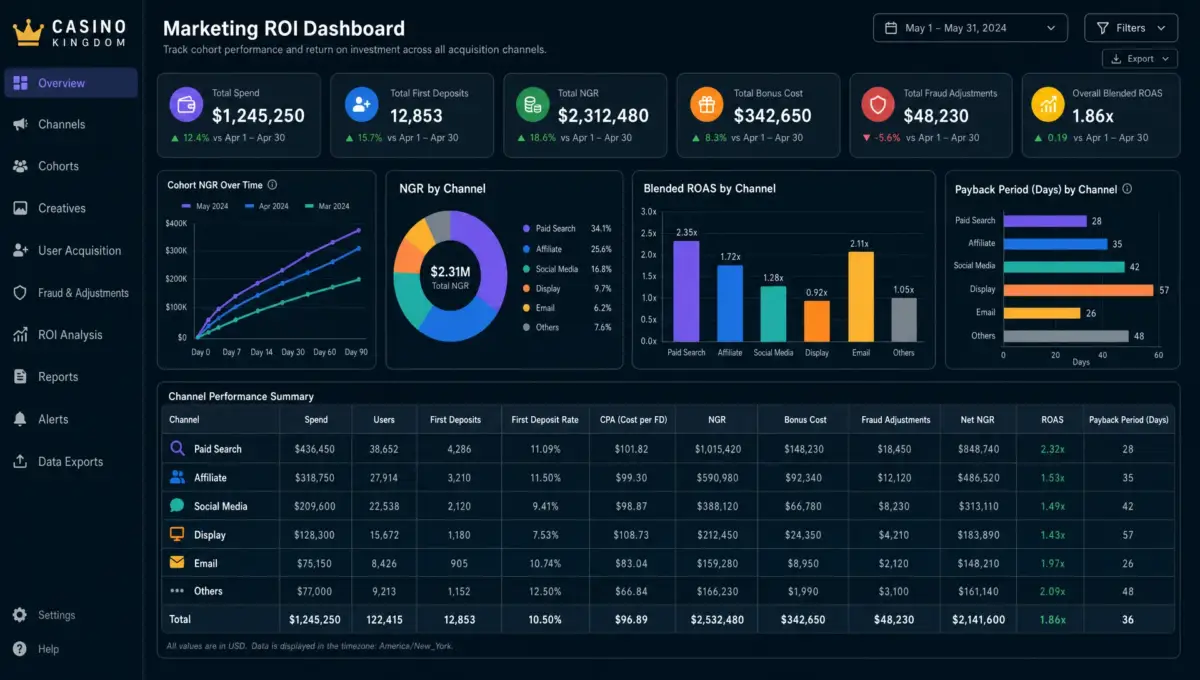
Include bonuses, affiliates and fraud in the cost side
Bonus cost is one of the most common reasons casino ROI is overstated. Free spins, matched deposits, cashback and loyalty rewards are not abstract engagement tools. They are economic incentives with real cost and margin impact.
The same applies to affiliate deals. A CPA deal may look clean because the cost is fixed per qualified player, but qualification rules matter. A revenue share deal may reduce upfront CAC but create a long-term margin commitment. Hybrid deals need even tighter reporting because part of the cost lands immediately and part follows the player over time.
If affiliates are an important channel, ROI measurement should include sub-affiliate quality, duplicate accounts, traffic source transparency, KYC pass rate, FTD rate, second deposit rate, bonus abuse and chargeback behavior. Spinlab’s article on building a high-ROI affiliate program for casinos goes deeper into structuring deals around player value rather than raw volume.
Fraud also belongs in ROI. Promo abuse, multi-accounting, payment fraud and chargebacks can turn a positive-looking campaign into a loss. Accurate reports should exclude invalid players and allocate confirmed losses back to the source that created them.
Choose an attribution model that matches the decision
No single attribution model answers every casino marketing question. Last-click attribution is useful for conversion optimization, especially when testing landing pages or payment flows. First-touch attribution helps identify discovery channels. Multi-touch attribution can be useful for larger operators with enough data quality and traffic volume.
For budget decisions, cohort profitability should be the final judge. A model may assign credit across touchpoints, but the operator still needs to know whether the acquired players produce contribution profit over a defined window.
A practical approach is to use different models for different jobs:
| Attribution model | Best use | Main limitation |
|---|---|---|
| First touch | Understanding initial discovery | Can overvalue awareness channels |
| Last click | Improving conversion paths | Can overvalue affiliates, retargeting or branded search |
| Position-based | Splitting credit between discovery and conversion | Still rule-based and subjective |
| Cohort-based profit | Budget allocation and true ROI | Requires connected data and time windows |
| Incrementality testing | Measuring real lift | Needs holdouts, clean segments or geo tests |
Retargeting deserves extra caution. It often converts players who already know the brand, so last-click reporting can overstate impact. Use holdout tests when spend is material.
Build a weekly casino marketing ROI dashboard
A good dashboard should help marketing, finance, product and risk teams make the same decision from the same numbers. It should not be a wall of charts. It should show where spend is going, what quality of players it creates and whether those players are becoming profitable.
A weekly dashboard can include the following blocks:
| Dashboard block | Core metrics | Decision it supports |
|---|---|---|
| Spend and volume | Spend, impressions, clicks, registrations, KYC pass rate | Identify funnel breaks and tracking issues |
| Funded conversion | FTDs, deposit attempts, payment success rate, average first deposit | Improve payment and onboarding performance |
| Player value | GGR, NGR, contribution profit, LTV forecast | Shift budget toward profitable cohorts |
| Incentive economics | Bonus claims, wagering completion, bonus cost, free spins cost | Reduce offers that create low-margin activity |
| Risk and compliance | Fraud flags, chargebacks, self-exclusions, duplicate accounts | Stop spend on harmful or invalid traffic |
| Retention | Second deposit rate, active days, churn, reactivation response | Separate one-time depositors from durable players |
This is where an integrated iGaming platform helps. When payments, games, KYC, bonuses, fraud prevention and analytics share data, the operator can move from static campaign reports to operational decisions. Spinlab’s breakdown of a casino analytics stack from events to profit actions is a useful next step if you are mapping the data architecture behind ROI reporting.
Example: turning a campaign report into an accurate ROI calculation
Assume a paid acquisition campaign produced these results over a 30-day measurement window:
| Item | Amount |
|---|---|
| Media spend | $20,000 |
| Creative and campaign setup | $2,000 |
| Bonus and free spins cost | $8,000 |
| Affiliate or placement fee | $3,000 |
| GGR from attributed players | $64,000 |
| Payment fees and chargebacks | $4,000 |
| Fraud losses | $2,000 |
| Game and content variable costs | $6,000 |
A shallow report might compare $64,000 in GGR with $20,000 in media spend and claim a 220 percent return before other costs. That is not accurate enough for casino budgeting.
A better calculation separates non-marketing variable costs from marketing investment:
Contribution before marketing = $64,000 minus $4,000 minus $2,000 minus $6,000 = $52,000
Marketing investment = $20,000 plus $2,000 plus $8,000 plus $3,000 = $33,000
Incremental profit = $52,000 minus $33,000 = $19,000
Casino marketing ROI = $19,000 / $33,000 x 100 = 57.6 percent
That is still a profitable campaign, but it is far less attractive than the headline GGR view. The more accurate calculation also reveals which levers matter. If fraud losses rise, bonus cost increases or payment success falls, ROI can change quickly.
Adjust for LTV without fooling yourself
Many casino campaigns do not pay back within the first few days. That is normal, especially for channels that acquire recreational players or markets where trust builds over time. The challenge is using LTV forecasts without turning them into wishful thinking.
A responsible LTV model should be based on historical cohorts with similar geo, channel, offer, payment method and game preference. It should show a range, not just a best-case number. It should also update as real behavior comes in.
For example, if a day 7 cohort has a lower second deposit rate than comparable historical cohorts, the forecast should drop. If payment approval rate, KYC pass rate or bonus completion is unusually strong, the forecast may improve. The model should follow the player data, not defend the original media plan.
Payback period is often the simplest guardrail. A campaign with strong projected LTV but a very long payback period can create cash pressure. Operators should define acceptable payback by market, channel and risk profile.
Common mistakes that distort casino marketing ROI
The most damaging ROI mistakes are usually basic reporting issues, not advanced analytics problems. Teams often optimize toward what is easiest to see rather than what is economically true.
Common mistakes include treating registrations as success, ignoring failed KYC, excluding bonus cost, crediting all revenue to last click, mixing markets with different tax and compliance costs, failing to remove fraud, using deposits instead of revenue, comparing immature cohorts with mature cohorts and reporting channel averages without sub-partner or creative-level detail.
Another frequent mistake is separating marketing analytics from product analytics. A campaign may look weak because the landing page is unclear, the cashier fails on mobile or the payment gateway rejects too many valid deposits. Before cutting a channel, check whether conversion friction is suppressing ROI. Spinlab’s guide to the anatomy of a high-performing casino landing page is useful for diagnosing that part of the funnel.
What accurate ROI measurement requires from your platform
Accurate measurement depends on the operating stack. At minimum, casino operators need reliable event tracking, player-level source attribution, payment data, game activity, bonus accounting, fraud signals, KYC status, affiliate tracking and backoffice reporting.
For crypto-ready operations, the measurement model should also account for crypto onramp behavior, wallet funding, multi-currency reporting and any payment-specific fees or settlement considerations. A crypto-ready solution can reduce friction for certain audiences, but ROI still depends on verified players, successful deposits and sustainable wagering behavior.
Spinlab is built as a modular all-in-one iGaming platform for launching and scaling online casinos, with support for crypto and fiat payments, game aggregation, KYC and AML compliance, fraud prevention, real-time analytics, affiliate and bonus tools, multi-currency support, open API integration and customizable backoffice administration. For operators that want a white label casino platform with a streamlined, Shopify-like management experience, those components matter because ROI measurement is only as good as the data the platform can connect.
FAQ
What is a good casino marketing ROI? A good ROI depends on market, license costs, margin, payback period and growth goals. A campaign can be acceptable with lower short-term ROI if it produces high-quality players with strong LTV and controlled risk. The key is to compare campaigns using the same cost and revenue definitions.
Should casino ROI be measured with GGR or NGR? NGR is usually more useful than GGR because it accounts for deductions such as bonuses, adjustments and certain fees, depending on your accounting rules. For budget decisions, contribution profit is even better because it reflects the actual economics of the campaign.
How long should the ROI measurement window be? Use multiple windows. Day 7 can reveal early quality, day 30 is useful for acquisition decisions and day 60 or day 90 can show whether LTV is developing. Mature cohorts are more reliable than early projections.
How do affiliates affect casino marketing ROI? Affiliates affect ROI through CPA payments, revenue share, hybrid commissions and traffic quality. The best analysis looks beyond FTD volume and includes KYC pass rate, second deposits, bonus abuse, fraud flags, chargebacks and long-term contribution profit.
Why can a campaign with many first deposits still lose money? First deposits do not guarantee profit. High bonus cost, low wagering, fast withdrawals, failed retention, payment fees, chargebacks or fraud can erase the value of a campaign that looks strong on funded registrations.
Turn ROI measurement into a growth system
Accurate casino marketing ROI is not a monthly spreadsheet exercise. It is a growth system that connects marketing spend to verified players, payment success, bonus economics, game activity, fraud risk, retention and long-term contribution profit.
If you are evaluating the platform behind that system, Spinlab gives operators a modular foundation for launching and scaling an online casino with integrated payments, game aggregation, analytics, compliance, fraud prevention and backoffice control. The more connected your operating data is, the easier it becomes to spend with confidence and cut waste before it compounds.
